

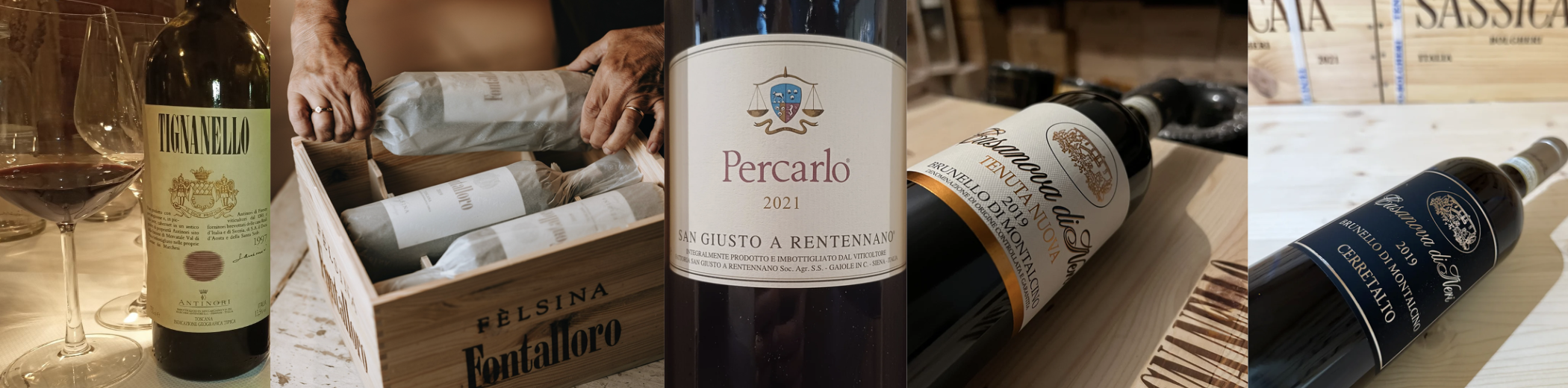
Defining Sangiovese: The Modern Greats
13 critically acclaimed wines, including five rare, museum releases.
The Producers:
Biondi-Santi | Casanova di Neri | Fèlsina | Il Marroneto | Il Poggione | Marchesi Antinori
Poggio di Sotto | San Giusto a Rentennano | Tenuta San Guido
"Le Pergole Torte isn’t a great Tuscan or Italian wine. It is simply one of the world’s elite wines."
Antonio Galloni, Vinous Media
“ This wine blew me away and remains one of my favourites…”
99 Points, Monica Larner, Robert Parker’s Wine Advocate on the 2021 San Giusto a Rentennano Percarlo Sangiovese
“… showstopper…The balance here is otherworldly. The 2019 Cerretalto displays all of the best attributes of this radiant vintage. Spellbinding.”
98 Points - Eric Guido, Vinous
Monday, June 15th
Hosted by Yasmeen Jansen, MW
Private Dinner: 6.30–9.30pm | 13 wines and 4 courses | $695
This is an intimate tasting of rare and remarkable wines, limited to just 14 guests. Secure your seats now through our Tasting Tickets.
-
Sangiovese is a grape variety closely tied to Tuscany, Italy, where winemakers use it to make the red wines of Chianti, Chianti Classico and Brunello di Montalcino. They also blend it into many Super Tuscan wines. Sangiovese, in general, produces medium to full-bodied wines with medium-to-full tannins, vivid red and black fruit flavors and distinctive peppery and savory accents.
Sangiovese wines are known for their naturally high acidity and generally noticeable tannin content that give a grippy, palate-cleansing texture to many of the wines. But, some versions can be light-bodied, fruity and vibrant, made to be enjoyed young, like Rosso di Montalcino and Rosso di Montepulciano.
Sangiovese grapevines are more vigorous than average and can produce very large crops. Grape growers often plant them on poor, rocky or sandy soil that is relatively low in nutrients. This helps restrict the vines’ production of canes and leaves so that the vines direct their energy into ripening the grape clusters.
Sangiovese is rare among the great wine grape varieties of the world in that it has enjoyed limited success making notable wines outside of its home country.
Sangiovese is the most widely grown red grape variety in Italy. It has been documented in Tuscany since at least the 16th century. Dry red table wines are by far the most common wine type that Sangiovese is used for, but rosés and sparkling wines can be found here and there.
Tuscany is the traditional home of Sangiovese, where it has long been a major element in fine Chianti Classico wines and is now often the only grape variety used in them. Simple Chiantis, elegant Chianti Classicos and Chianti Classico Riservas all use mostly Sangiovese grapes. Winemakers in Umbria, the Marche, Romagna and many other spots of Central and Northern Italy use Sangiovese as well.
The most full-bodied, structured and age-worthy type is Brunello di Montalcino, which is also the only Tuscan wine that is required to be made only from Sangiovese grapes. The clone or selection of Sangiovese grown in this small section of southern Tuscany is Sangiovese Grosso, named for its large grape clusters.
Brunello di Montalcino wines and Super Tuscan wines have both gained world renown and status as collectibles that can age and improve for decades.
Wine Enthusiast -
Until relatively recently Sangiovese, Italy's most widely planted vine variety, was a grape in the wilderness. And whenever the name Sangiovese did appear on a label it was far from a guarantee of greatness. Rather the reverse. The most common wines that carried the name Sangiovese on the label were Sangiovese di Romagna, cheap Italian reds which were typically extremely light, pale, tart confections with little of interest to offer the wine lover.
Sangiovese is and has always been THE dominant grape of central Italian red wines. Because in the mid 20th century Chianti was frequently lightened with the addition of tart, pale-skinned Trebbiano grapes and stretched by the addition of fuller reds imported in bulk from the south of Italy and the islands, it was far from easy to determine what Sangiovese's innate qualities were. It has been only since the late 20th century, thanks to a systematic research programme by producers in the Chianti Classico heartland of the greater Chianti region, that the myriad clones of Sangiovese grown all over central Italy have been studied and assessed.
After years of research it has emerged that two of the finest clones, R24 and T19, are in fact from Romagna. A fascinating tasting of some of the most promising vine selections in 1996 with Paolo De Marchi of Isola e Olena in the heart of Chianti Classico country included a range of almost a dozen different Sangioveses. The R24 had the most sumptuous mulberry flavours whereas one selected by the University of Florence (SS-F9-A 5-48 was its romantic name) was much tarter and simpler, one from Montalcino was almost too soft and another from Corsica (where Sangiovese is known as Nielluccio, or more often in local dialect Niellucciu) was sweet and almost oaky-tasting.
Sangiovese's dominant viticultural characteristics are that it can vary as much as Pinot Noir in its sensitivity to place and that it ripens relatively late. This means that if it is planted in too cool a location it can produce wine that is tart and unripe, though warming summers mean this is less and less of a problem. The Chianti Classico research programme concentrated on trying to match suitable clones to the varied local conditions of this quite extensive region whose upper reaches were at the limit of successful grape-ripening territory. The official Consorzio (growers’ association) originally favoured a clone that produced dark, concentrated wines, but it has a relatively shallow root system and low acidity, disadvantages in today’s hot, dry summers. Many of the best producers deliberately try to have a range of different selections in their vineyards and therefore wines.
In the bad old days, Sangiovese tended to be overproduced, which accentuated its tendency to exhibit high acid and unripe tannins. Thanks to its thinnish skins and frequent blending with white grapes, this all too often meant that the wines turned brown after only a few years in bottle.
Today, fine Sangiovese is an altogether nobler wine with real complexity and ageing potential, whatever its depth of colour and concentration. As for the elusive flavour of pure Sangiovese, it ranges somewhere between mulberries, raspberry and cherry (from cooler sites), spice, tobacco, sometimes leather and chestnuts. It tends to be savoury rather than sweet, and if not fully ripe can smell distinctly farmyard-like.
Chianti Classico may still be a blended wine, but the tendency nowadays is to make it with an increasingly high proportion of Sangiovese – often 100%. There was a vogue in the late 1970s and 1980s to minimise Sangiovese's role and blend in very obvious proportions of Cabernet and Merlot, often ageing the wine in imported French barriques rather than the traditional large, upright Slavonian oak casks known as botte.
But now that the right clones have been identified and are increasingly popular, Sangiovese is allowed to shine in all its glory without depending on make-up imported from Bordeaux. The much-amended Chianti Classico regulations now allow producers to add a total of up to 20% of other varieties, but most of the finest wines are made entirely from Sangiovese. And if other grapes are added, they are today just as likely to be the traditional and local scented Mammolo, the rather ordinary Canaiolo and/or the deep-coloured Colorino as Cabernet and Merlot. (Since 2006 white grapes have been outlawed from Chianti Classico.)
Perhaps the most famous selection of Sangiovese was first isolated by Ferruccio Biondi Santi of the hilltop town of Montalcino in southern Tuscany in the late 19th century and, as BBS11, is the only registered clone to be named after a producer. This particularly deep-coloured, tannic selection is known as Brunello and thus Brunello di Montalcino, one of Italy's most noble and long-lived wines made entirely of this local vine speciality, was born. Brunello tends to need many more years in bottle to develop than even the sternest Chianti Classico but the DOC Rosso di Montalcino identifies the earlier-maturing reds of the region. Many would argue that fine Brunellos such as Biondi-Santi, Conti Costanti, Il Marroneto, Poggio di Sotto, Il Poggione and Gianfranco Soldera represent the finest examples of Sangiovese of all.
Just to the east of Montalcino, around the town of Montepulciano, there is a similar system for the local wines, known as Vino Nobile di Montepulciano, whose local strain of Sangiovese is called Prugnolo Gentile. Quality here has been improving steadily of late, with Rosso di Montepulciano playing a similar role to its counterpart from Montalcino.
On the southern Tuscan coast, Sangiovese goes under the alias Morellino and makes particularly toothsome wine in unusually acid soils around Scansano, but much of the Maremma is regarded as too warm for Tuscany’s signature variety. The Montecucco zone, for example, is too extensive and varied in terms of soils and altitude to offer consistency.
Sangiovese is still the standard red grape of the Romagna region, and it is still easy to find vapid, pale, stretched examples but producers such as Zerbina have shown that top-quality Sangiovese is also bottled in this region. The Stella dell’Appenino group of producers has helped trigger a new generation of producers interested in making fine Romagna Sangiovese with the firm stamp of terroir.
In Umbria, to the south, Sangiovese is the standard red vine and can make some delicious Montefalco Rosso, in conjunction with the tannic local Sagrantino, while as Nielluccio, the Sangiovese vine is the most widely planted vine on the French island of Corsica. Vine growers are becoming increasingly curious and Sangiovese is now planted throughout the Americas. California had a major flirtation with it. The results have been decidedly mixed but Shafer with their Firebreak blend, predominantly Sangiovese, has managed admirable consistency. Argentina with its considerable Italian immigrant population also has quite a bit of Sangiovese (and Nebbiolo) planted, but it is still to perform even half as well as the dominant Argentine vine Malbec. And in Australia Coriole and Pizzini have shown that Sangiovese can thrive in such different wine regions as McLaren Vale and the Victorian Highlands.
Some top wines, apart from Brunello di Montalcino, that have long been made predominantly from Sangiovese are Flaccianello (from Fontodi, Chianti Classico), Le Pergole Torte (Monte Vertine, Chianti Classico), Zerbina Riserva Pietramora (Zerbina, Romagna), Asinone (Poliziano, Vino Nobile di Montepulciano) and Poggio Valente (Le Pupille, Morellino di Scansano).
-
Yasmeen Jansen MW is a specialist medical practitioner, and the development of her expertise in wine began with her involvement in tasting groups with colleagues. Her love affair with wine was cemented when she lived in Italy for two years, during which time she developed an affinity for, and in-depth knowledge of, Italian wines. Yasmeen's passion is for wine education and appreciation, and this has inspired her MW journey. Tastings led by Yasmeen are fun and informative and involve a deeper exploration of the varieties and regions covered.
About the Master of Wine Title
The Master of Wine qualification indicates that the title recipient has completed the toughest series of examinations on viticulture, wine making styles and techniques, all wine regions, and all pluses and minuses in the marketing of these wines on planet. Then added to this is the requirement for an extraordinary ability to discern the bouquet & flavour nuances caused by the factors above which indicate the wine’s variety, age, wine making techniques used, regions, quality, hygiene and seasonal variations.
Thousands of young wine people from all over the world, from dozens of countries, start the courses each year but perhaps only 8-15 per year worldwide graduate. There are only about 380 Masters of Wine worldwide.
The title MW is the greatest imprimatur or recognition that the wine world can give to its most able students.
After 50 years of Master of Wine graduates there are just 2 in Western Australia and perhaps 24 in Australia.
The Wines
First bracket
2013 Fèlsina Fontalloro Sangiovese [Museum Release]
Gorgeous and soft, the 2013 Fontalloro is another landmark wine from this classic vintage. There is enormous intensity here and the wine is only at the beginning of its long aging trajectory. I suggest you put off drinking it for five to ten more years. There is evident thickness and generosity here, especially in the way those bold fruit favors are woven between dark spice and leather. There are sour accents on the close that remind you of the wine's youth. The tannins are fine and well integrated.
96 Points - Monica Larner, Robert Parker’s Wine Advocate (December 2016)
2019 Fèlsina Rancia Riserva Chianti Classico Sangiovese
Darker fruit on the nose with walnut, spice box, incense and espresso bean, too. Medium-bodied, firm and structured with polished tannins and a creamy, compact mid-palate. Quality dark oak spice throughout. Long and rich. Better from 2024.
95 Points - James Suckling, JamesSuckling.com (July 2022)
2021 San Giusto a Rentennano Percarlo Sangiovese
This wine blew me away and remains one of my favorites in this report. The organic San Giusto a Rentennano 2021 Percarlo is all Sangiovese and represents excellent work by detail-minded vintner Luca Martini di Cigala. It shows delightful intensity and richness backed by chiseled fruit and lifted aromas of blackcurrant, spice, tar, earth and violet. There is power here, but the wine is also delicate. I love the determination of this vintage. Percarlo plays beautifully on the nose and over the palate with freshness, chalky tannins and lingering fruit. There's nothing heavy about it. It ages in 500-liter and 30-hectoliter oak casks for 22 months. Production is 18,528 bottles.
99 Points - Monica Larner, Robert Parker’s Wine Advocate (October 2025)
Second bracket
2018 Il Poggione Brunello di Montalcino Magnum Sangiovese
The dense structure sets the pace for this red, with cherry, raspberry, mint and tar flavors that are appealing and expressive. Reveals rose hip, orange peel and earth details as this winds down on the long, expansive aftertaste. Built for the long term. Best from 2026 through 2046. 16,000 cases made, 450 cases imported.
94 Points - Bruce Sanderson, Wine Spectator (June 2023)
2020 Il Marroneto Brunello di Montalcino Sangiovese
The Il Marroneto 2020 Brunello di Montalcino is a wine of special depth and elegance. Alessandro Mori tells me that fermentation in 2020 proceeded nicely with what he describes as a primordial stew of grape must, resulting in high pressure geysers or liquid bombs that rip right through the cap because of pressure build-up. Someone is having tons of fun in the winery. High temperatures (between 36 to 38 degrees Celsius) serve to fix the wine's ruby color and the elegance of its perfumes, which are more floral than fruity. At the end of fermentation, he manages the skins with light wetting by hand with a tube. This vintage offers softness and a silky texture that feels glossy to the palate.
96 Points - Monica Larner, Robert Parker’s Wine Advocate
2019 Casanova di Neri Tenuta Nuova Brunello di Montalcino Sangiovese
In my mind, this is the wine that best represents the Casanova di Neri house style. With 30 months of aging in tonneaux, it shows enormous richness and texture, and the stellar fruit quality appears with more primary elegance compared to the more expensive Cerretalto that is released with an extra year of aging. That dynamic is especially pronounced in a comparison of the 2019 and 2018 vintages. The 2019 Brunello di Montalcino Tenuta Nuova has a dark vein of toasted spice, black fruit, ink, blackberry compote, licorice and star anise. Dark as night, it is exceptionally well crafted with a robust delivery of concentrated fruit and solid tannic structure. You can count on excellent cellar potential, or at a minimum, serve it with a classic steak.
97 Points - Monica Larner, Robert Parker’s Wine Advocate
Third bracket
2019 Biondi-Santi Brunello di Montalcino Sangiovese
Expansive, even exuberant, this is a Brunello that pushes back against expectations in a graceful and most welcome way. A satisfying density anchors the soaring acid and ripe but still tart fruit.
96 Points - Danielle Callegari, Wine Enthusiast
2019 Poggio di Sotto Brunello di Montalcino Sangiovese
The nose opens peppery and flinty, with aromas of damp soil and wild thyme, before bing and black cherry notes eventually emerge. Those cherries stretch out on the palate, over a slather of bitter orange jam, held in place by firm yet flexible tannins.
96 Points - Danielle Callegari, Wine Enthusiast
2019 Casanova di Neri Cerretalto Brunello di Montalcino Sangiovese
The 2019 Brunello di Montalcino Cerretalto is a showstopper, with a bouquet that mixes hauntingly dark florals, black cherries, incense, exotic spices and sweet sage. It seduces the senses with silken textures and ripe wild berry fruit scents, taking on a steady tension as hints of blood orange and an air of violet florals saturate the palate. It finishes structured and impossibly long as a primary concentration lingers, leaving a stain of blackberry and sour cherry, all framed by regal tannins. The balance here is otherworldly. The 2019 Cerretalto displays all of the best attributes of this radiant vintage. Spellbinding. Drink 2028 – 2040.
98 Points - Eric Guido, Vinous
Fourth bracket
2023 Tenuta San Guido Le Difese Sangiovese
The 2023 Le Difese includes Sangiovese from Montosoli and Rufina in Chianti Classico in the blend. The nose is fresh and pure, with a juicy, floral perfume of fresh red berries, violets, and wet stone. It’s fresh and inviting on the palate, with the very pretty elegance that the Sangiovese brings with its more defined structure and refreshing feel. This is a fabulous entry wine to drink over the coming 8-10 years.
93 Points - Jeb Dunnuck
2018 Montevertine Le Pergole Torte Sangiovese [Museum Release]
Clear, bright ruby with a light rim. Inviting, very finely drawn nose, aromas of raspberries, sour cherries and fresh plums, very clear. Plucky, substantial tannins that build up in layers, fine spice components, full-bodied drive on the finish, can age for a long time.
97 Points - Falstaff
2011 Antinori Tignanello Sangiovese Cabernet Cabernet Franc [Museum Release]
Ruby, rose, clear color. Fresh grapes, red fruit, marble and stone on the nose. Paprika, some cinnamon and fresh cherry on the palate. Light tannins develop structure and complexity. Sangiovese and cabernet sauvignon. Better in 2016.
95 Points - James Suckling, JamesSuckling.com
1997 Antinori Tignanello Sangiovese Cabernet Cabernet Franc [Museum Release]
The 1997 Tig has a kind of lore to itself. Legendary, or some such. Seen it a few times but not sure I was note taking on those occasions. Nor was it next to 2013, 2010, 2007, 2005 and 2001 when I tried it previously. Handy help. Good year for Super Tuscans.
Mature, savoury, leathery, dried fruits, shellac, meaty, wet tarmac and sniffs of sweeter black berry fruit character. Lovely carriage and presence in the palate with dried fruits, ferrous character, lick of iodine, finishing inky, savoury with firm tannins and a steady drive through to a fine point. Plenty to enjoy about this wine. Shows well. Mellow maturity is all here, pleasure in that place.
94 Points - Mike Bennie, The Wine Front (April 2016)