

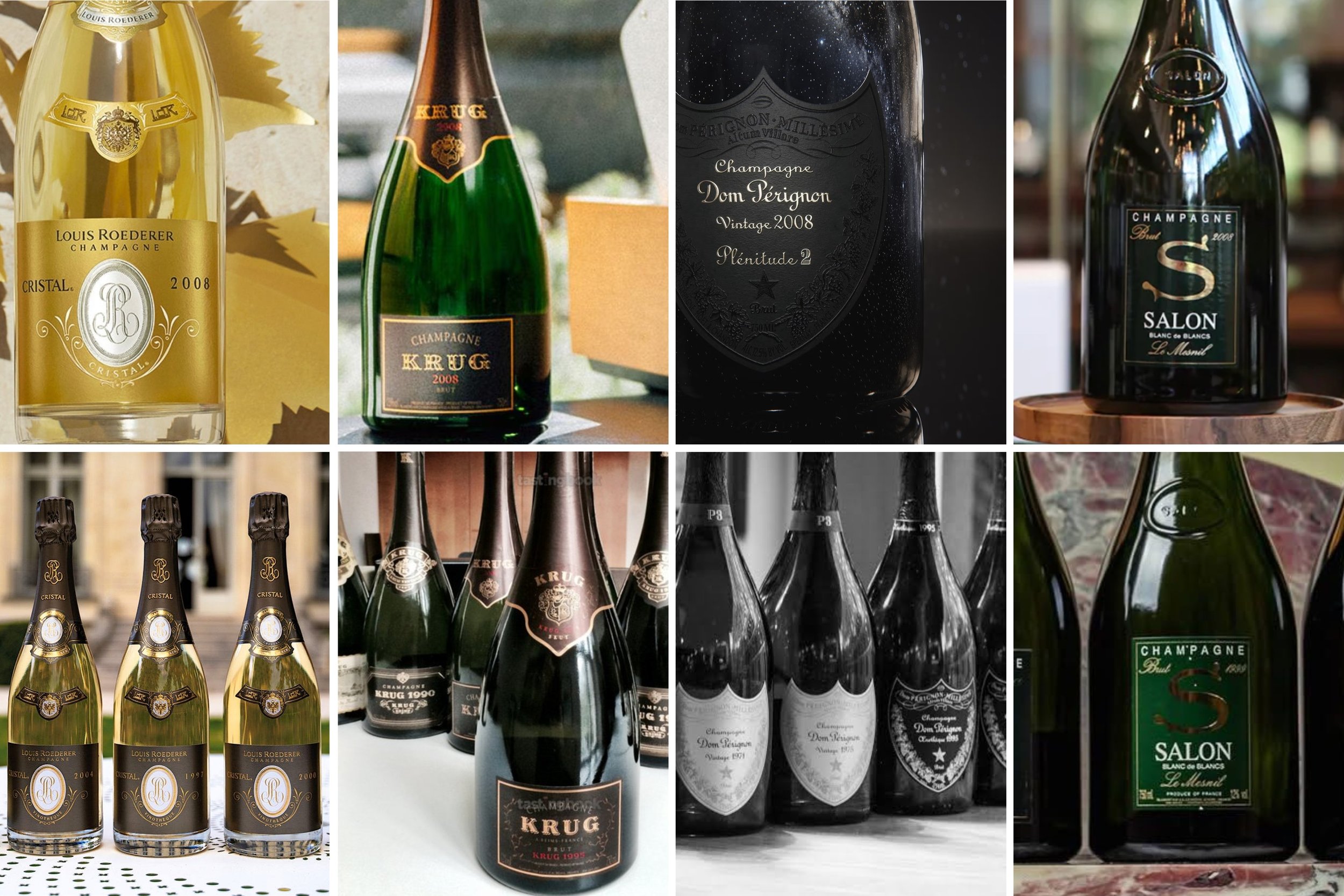
The Great Houses, from the Greatest Years
Krug · Cristal · Dom Pérignon · Salon
Between them they invented the idea of the prestige cuvée, and they have spent the last century and a half defending it.
This is the night all four come to the table together, and not with their current releases. Fourteen wines drawn from eight of the greatest vintages of the modern era:
1985, 1990, 1992, 1996, 1999, 2000, 2006 and 2008.
Seven of them poured from magnum. Several of them no longer exist in commerce at any price.
Your host is Tyson Stelzer, author of The Champagne Guide, International Champagne Writer of the Year, and a man who has spent more than fourteen years tasting alongside every chef de cave of note in the region.
Champagne is very rarely served this way. Places are strictly limited.
Friday, November 20th
Hosted by multi-award winning wine writer, television host, producer,
author and Champagne Master - Tyson Stelzer
Dinner: 7pm, 14 of the World’s greatest Champagnes, 5 courses | $4,995
Restaurant book-out (limited to 20 guest maximum)
The Four Houses:
-
Reims, founded 1843. Owned by LVMH since 1999, with the family still in place. Chef de cave Julie Cavil since 2020.
Joseph Krug was a Mainz butcher’s son who spent eight years at Jacquesson before leaving, in 1843, to found a house on a heretical idea. Every other great name in Champagne is built on the declared vintage, on the proposition that some years are worth bottling and most are not. Krug’s founding conviction was the opposite: that a truly great Champagne should be possible every single year, whatever the weather did.
Delivering on that takes an almost absurd amount of machinery. Every plot is pressed and vinified separately, around 250 individual wines from each harvest, each fermented in small 205 litre oak casks that are deliberately old and seasoned for years before they touch a cuvée. The oak is there for texture and a whisper of oxygen, not for flavour. Alongside the current year sits a library of some 150 reserve wines spanning about fifteen vintages, and every year the tasting committee works through roughly 400 individual wines.
Which raises the obvious question. If the whole point of Krug is to transcend the vintage, why make a vintage wine at all? The house’s own answer is the best thing to know before the 2008 is poured: Krug Vintage is not the selection of the best wines of a good year, but the selection of the wines which better express the story of the year. Grande Cuvée is Krug overcoming the season. Krug Vintage is Krug surrendering to it, with no reserve wines and no safety net.
Krug is also the only house here that takes all three grapes seriously. Dom Pérignon uses two. Salon uses one. The 2008 contains more Meunier than Chardonnay.
On the table: Krug 2008, Krug 1996 in magnum, and Krug Clos du Mesnil 1992. The Clos is a walled vineyard of 1.84 hectares in the middle of Le Mesnil-sur-Oger, enclosed since 1698, which Krug bought in 1971 from Salon. It is the only one of Salon’s original plots ever to change hands, so the evening offers something almost nobody gets to do: a Salon and a Clos du Mesnil, the same grape in the same village, one wall apart, from two diametrically opposed philosophies.
-
Reims, founded 1776. Family owned. Chef de cave Jean-Baptiste Lécaillon since 1999.
In 1876, at the request of Tsar Alexander II, Roederer created a cuvée for the imperial court alone. It was bottled in clear lead crystal, hence the name, with a flat bottom and no punt so that nothing could be concealed in the base of the bottle. Five years later the Tsar was assassinated by a bomb, which is perhaps why the story has proved so durable. What is not in dispute is the consequence. Cristal is generally regarded as the first prestige cuvée ever made, roughly half a century ahead of everything else on this table. Every other wine here is, in one sense, its descendant.
2026 is a double anniversary: 250 years of the house, and 150 years of Cristal.
Roederer remains family owned and independent under Frédéric Rouzaud, the seventh generation. It farms around 250 hectares across some 420 individual plots and describes itself as the largest organic vineyard estate in Champagne. Every one of its vintage wines is made entirely from fruit the family grows itself, which is highly unusual at this scale. Cristal draws on 45 plots across the Montagne de Reims, the Vallée de la Marne and the Côte des Blancs, all farmed biodynamically since the 2012 vintage.
In the cellar the signature is subtraction. Malolactic fermentation is blocked to keep the acidity and the salinity intact. There are no reserve wines, so Cristal is assembled from plots rather than from years. Dosage has fallen steadily as the farming has improved. The wine is even bottled at lower pressure than the industry norm, so the bubble itself is softer.
"The essence of Cristal is chalk. A return to the origins… I wanted to get back down to the ground." Jean-Baptiste Lécaillon, chef de cave
On the table: the 2008 Late Release, the 150th anniversary bottling and the wine of the night, disgorged in March 2022 after thirteen years on its lees and then rested four more years under cork; the 1999 in magnum, from the ripest, softest year of the eight, with the lowest acidity in Champagne since 1959; and the 1985 in magnum, made by Lécaillon's predecessor in a year when a winter of minus twenty and then spring frost cut the crop to two thirds of normal, and picking did not begin until the thirtieth of September.
-
Hautvillers. First vintage 1921, released 1936. Moët & Chandon, within LVMH. Chef de cave Vincent Chaperon since 2019.
Dom Pierre Pérignon was a real man and a considerable winemaker, and almost everything popularly said about him is wrong. He did not invent sparkling wine. In his world a second fermentation in bottle was a fault, one that burst glass and injured cellar workers, and he spent his career trying to prevent it. Nor is there any contemporary record of "come quickly, I am drinking the stars"; it surfaces more than a century after his death. What he actually invented was assemblage, and assemblage is precisely what the wine bearing his name is built on. There has never been a non-vintage Dom Pérignon, and a vintage is declared only when the year earns it. No 2014 was made at all.
Plénitude, Œnothèque, P2, P3. This is the one thing worth explaining, and once it lands the confusion disappears. These are not different wines. They are different release moments of the same wine. The house's view is that a vintage does not improve along a smooth curve but passes through distinct windows of expression, and it releases the wine more than once, at those windows. The bottle sold simply as Dom Pérignon Vintage is the First Plénitude, at around eight or nine years, the year finding its harmony. P2 comes at fifteen or sixteen years, after twelve to fifteen years on lees, and is about energy and intensity. P3 comes at thirty to forty years and is about what the house is content to call wisdom. Œnothèque is simply what P2 was called before May 2014. Harmony, then energy, then wisdom.
One point of honesty. Dom Pérignon is by far the largest volume wine on this table. The rarity here is not the brand, it is the bottling. P2, P3 and the old Œnothèques are tiny releases, and the 1990 and 1992 Œnothèques no longer exist in commerce at all.
On the table: four wines, every one of them made by Richard Geoffroy, chef de cave from 1990 to 2018, a trained medical doctor and the man who built the Plénitude framework in the first place. Plénitude 2 2008, fifteen years on lees, disgorged September 2023. Œnothèque 1992 and Œnothèque 1990 in magnum, both late disgorged at about half the standard dosage, with their disgorgement dates printed on the back labels. And Rosé 2000 in magnum, in the Luminous presentation, its crest label lit from within and glowing for eight to ten hours. The Luminous is a presentation format, not a different wine.
-
Le Mesnil-sur-Oger. First vintage 1905. Laurent-Perrier group since the late 1980s. President Didier Depond since 1997. Eugène-Aimé Salon was born in 1867 at Pocancy, at the foot of the Côte des Blancs, the son of a cart maker. He went to Paris, made a fortune in the fur trade, and became a fixture of Belle Époque society. Then he did something no commercial logic supports. He set out to make one perfect Champagne, for himself, his family and his friends. The first came from the 1905 harvest and was never offered for sale. It is widely held to be the first blanc de blancs. His conviction was that Chardonnay alone, generally thought far too slight to carry a Champagne, could produce a great wine if it were given enough time. Not power through blending. Power through patience. The house states its terms in four words: one terroir, one cru, one grape, one year. But the absences matter more than the presences. There is no non-vintage Salon. There are no reserve wines. There is no second label and no blending across villages, grapes or years, so there is nothing whatsoever to hide behind. Only the first, finest pressing is used. Fermentation is in stainless steel with no oak at all. Malolactic fermentation is blocked outright, to preserve the acidity and salinity that Depond regards as Le Mesnil's signature. The wine spends eight to ten years on its lees before release, at a dosage that never exceeds 8 g/l. Riddling is still done by hand. And when the year does not warrant it, Salon makes nothing at all, and the fruit goes next door to Delamotte. Roughly forty-five vintages have been declared since 1905. Three or four a decade, in 120 years. Set against Krug, Salon is the most instructive pairing available in Champagne. Krug's answer to a difficult year is a library of 150 reserve wines. Salon's answer is to make nothing. If Krug is the most additive Champagne ever conceived, Salon is the most subtractive, and tonight they are sitting at the same table. On the table: the 2008 in magnum, the forty-second vintage, which exists only in magnum, 8,000 of them and not a single 750ml bottle, ever; the 2006, the fortieth vintage, at 4 g/l, from a warm year most houses hesitated over; and the 1996, the wine that makes the entire argument for the house.
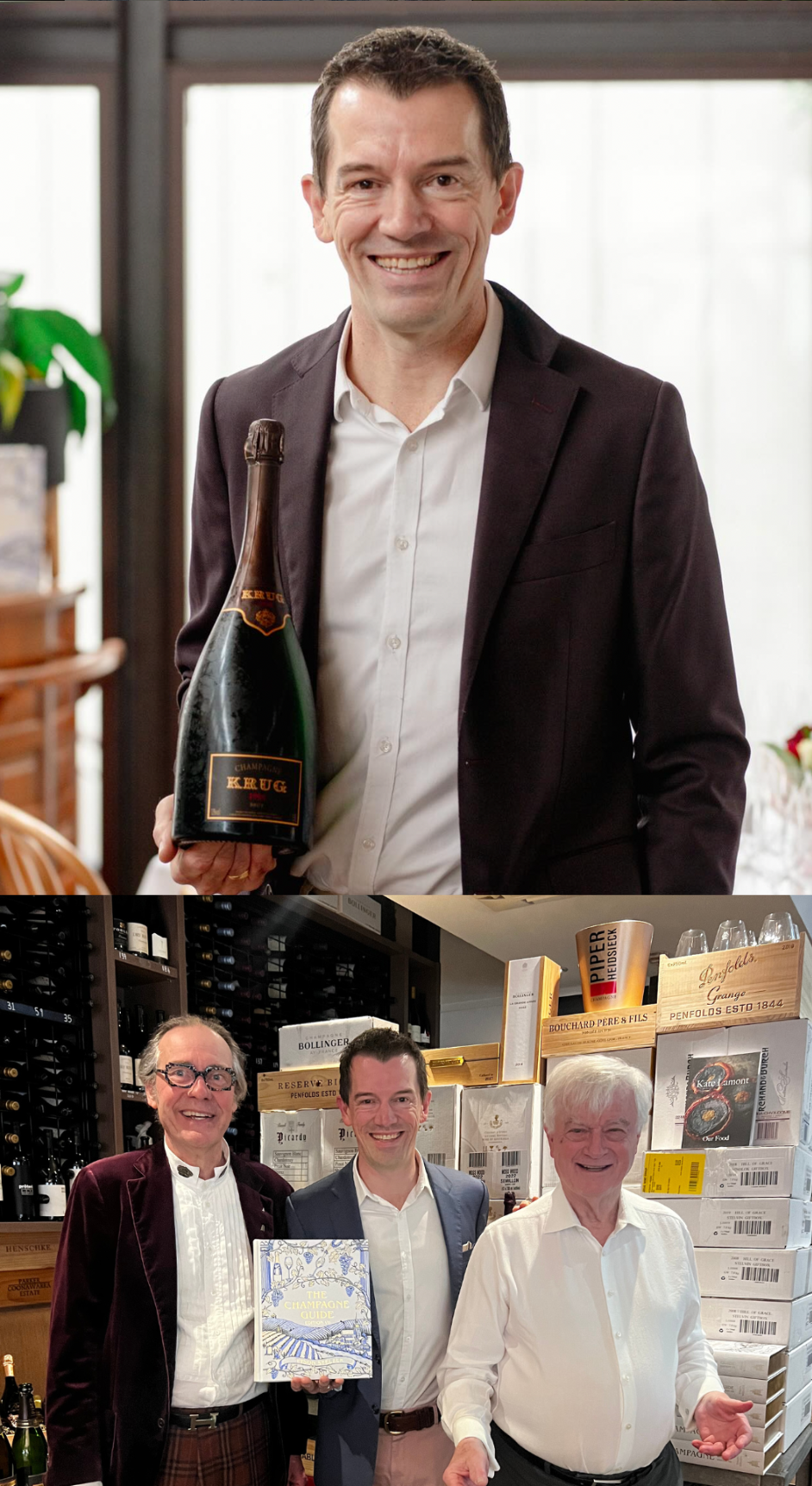
Tyson Stelzer | Our Host
Tyson Stelzer is a multi-award-winning wine writer, television host and producer, author of 18 wine books, international keynote speaker and wine show chairman and judge. He was named The International Wine & Spirit Communicator of the Year 2015 (in the International Wine & Spirit Competition), the Australian Wine Communicator of the Year 2015 and 2013 (The Wine Communicators of Australia) and The International Champagne Writer of the Year 2011 (in The Louis Roederer International Wine Writers’ Awards).
In 2021 he was named the Most Influential Opinion Maker in the annual power list of Who’s Who in Australia by Meininger’s Wine Business International (Germany).
As a television presenter, Tyson is the host and producer of the People of the Vines series. He is the author of six editions of The Champagne Guide, a regular columnist for many magazines, and a contributor to Jancis Robinson’s The Oxford Companion to Wine.
As an international speaker, Tyson has presented at wine events across Australia, France, Italy, Austria, Greece, Montenegro, the US, UK, Japan, Hong Kong, South Africa and New Zealand . He is a regular judge and chairman at wine shows throughout Australia and is a co-creator with UK wine writer Matthew Jukes of The Great Australian Red Competition and The Great New Zealand Pinot Noir Classification. Tyson is a tutor at the Len Evens Tutorial, considered to be the most exclusive wine school in the world.
He is the creator and host of The Champagne Tour, the Advanced Champagne Certificate and of Taste Champagne, the biggest global champagne showcase, with events across Australia, the UK and Hong Kong.
Tyson is the founder and director of Teen Rescue Foundation, a charity to actively discourage and reduce harmful alcohol use and its consequences among under-age teens. He has raised more than $468,000 for charities through his philanthropic initiatives over the past decade.
He is a winner of the Best French Wine Book in Australia 2020 and 2014, Best Digital Wine Book in Australia 2017, Digital Wine Communicator of the Year 2015, Best Wine Book of the Year 2014, Best Trade or Technical Writer of the Year 2013 and the Award for Best Food and Wine Writing 2008.
Tyson Stelzer’s status as a wine writer and author continues to soar.
James Halliday
Stelzer is a persuasive new voice… the new kid on the block with a very bright future.
World of Fine Wine, UK
Tyson Stelzer is one of Australia’s youngest, most serious and greatest wine writers.
John Jens Lamont’s Wine Store, Perth
Of the new generation of Champagne specialists, Tyson Stelzer is certainly one of the most interesting.
Decanter Magazine, UK
Stelzer has been in the game just 15 years but he could well be the next James Halliday, such is his intellect, organisation and communication skills, work ethic, humility and above all his palate.
Wine Business Magazine
tysonstelzer.com
The Champagnes
First Course: Cristal
2008 Louis Roederer Cristal Brut, Late Release
100 Points, Antonio Galloni, Vinous
The 2008 Cristal Late-Released is a special cuvée bottled to celebrate Cristal's 150th Anniversary. It spent an added four years on the lees, which places it between the regular release and the Vinothèque in terms of aging. Explosive in the glass, the 2008 possesses off-the-charts textural richness and density, much of that coming from the shaking of the bottles during élevage (poignettage). That extra mid-palate resonance fills out the layers, resulting in a Cristal that is utterly profound. Unforgettable.
1999 Louis Roederer Cristal Brut, magnum
97 Points, Jancis Robinson MW, JancisRobinson.com
Lovely richness on the nose with real spread of crème pâtissière but very tight and refreshing too. Very satisfying. At peak and very flattering. Long and fresh. Spreads opulently but not dully across the palate. So complete. Such lovely neatness.
1985 Louis Roederer Cristal Brut, magnum
99 Points, Mike Potashnik & Don Winkler, International Wine Review
The combination of a good vintage and time has resulted in a complex, yet precise and focused Champagne. The bouquet reveals earthy mushrooms, minerals, and baked bread, which are picked up on a richly textured, perfectly balanced palate, finishing with great persistence. It is a truly magnificent Cristal.
Second Course: Krug
2008 Krug Vintage
100 Points, James Suckling, JamesSuckling.com
This is very structured and framed with an almost red sensibility. Very phenolic. Full-bodied in a tightly wound ball with so much going on. Very pinot like. Mineral and stone. Shell and stone. Iodine. Vinous. The bubbles just fade into the finish of the wine, which goes on for minutes. Turns to toffee and salted caramel with time in the glass. One for the cellar. Great length.
1996 Krug Vintage, magnum
98 Points, Antonio Galloni, Vinous
Krug's 1996 Vintage is insanely beautiful. Vivid, alive and vibrant, the 1996 presents searing intensity and power. What a privilege it is to taste the 1996 from magnum. Readers who might still be able to find the 1996 at a reasonable price should not hesitate.
1992 Krug Clos du Mesnil
98 Points, Richard Juhlin, Decanter
Breathtakingly good with a wonderful lightness of being, this is so mature and soft with a fine clear lemon tone, faint barrel character and exquisite honey essence. An utterly compelling example of Clos du Mesnil's vineyard style and character.
Third Course: Dom Pérignon
2008 Dom Pérignon Plénitude 2
100 Points, Antonio Galloni, Vinous
The 2008 Dom Pérignon P2 is a stunning, riveting wine. Bright, crystalline and focused, the 2008 dazzles from start to finish. Crushed rocks, slate, mint, dried herbs, lemon oil and oyster shell sizzle with tension. A Champagne of linear focus and cut, the 2008 is absolutely stunning. The original release of the 2008 was a total knockout; now, some years later, the P2 edition takes all of its inherent qualities and amplifies them, while also adding new layers of complexity. This is unforgettably profound.
1992 Dom Pérignon Œnothèque
95 Points, Richard Juhlin, ChampagneClub.com
No tasting note is published alongside the score. A library release under the pre-2014 Œnothèque name, late disgorged and at roughly half the standard dosage, from the year Dom Pérignon declared and Salon did not.
1990 Dom Pérignon Œnothèque, magnum
95 Points, Josh Raynolds, Vinous
Silvery gold color, with a very fine mousse. Absolutely stunning aromatics: pungent iodine, oyster shell, oatmeal, toasted wheat and bitter lemon. This smells like top-notch Chevalier-Montrachet from a great vintage. Broad and deep but also very fresh and bright, with suave, toasty citrus and smoke flavors accented by exotic spices. This expands impressively on the back, finishing with great impact, an impression of strong extract, and notes of bacon fat, toffee and minerals.
Fourth Course: Salon
2008 Salon Le Mesnil Blanc de Blancs, magnum
100 Points, Antonio Galloni, Vinous
I knew it the moment I tasted it. The 2008 Cuvée S, bottled only in magnum, is perfect. I can ask nothing more. Citrus, sage, mint, white pepper, crushed rocks and oyster shells explode onto the palate. Complex and nuanced, with tons of saline intensity, the 2008 is an archetype. A truly great vintage for one of the most important wines in Champagne.
2006 Salon Le Mesnil Blanc de Blancs
97 Points, Antonio Galloni, Vinous
The 2006 Cuvée S is powerful, dense and imposing. All of the natural intensity of this warm year races across the palate. Orchard fruit, jasmine, dried flowers and soaring tropical overtones fill out the layers. The 2006 is exceptionally beautiful today, but it also has a ton of room to grow.
1996 Salon Le Mesnil Blanc de Blancs
100 Points, Charles Curtis MW, Decanter
This is monumental. The aromas begin with bright citrus, mineral, and saline notes and gain in amplitude with time in the glass to reveal a more exotic, almost tropical side, a well-integrated note of brioche, and just a suggestion of fresh creamery butter. The texture is still almost laser-like, with racy lemony acidity and a powerful combination of extract and vigor that carry it to a long, vigorous finish.
To Finish…
2000 Dom Pérignon Rosé, Luminous Edition, magnum
96 Points, Antonio Galloni, Vinous
The 2000 Dom Pérignon Rosé is just starting to enter its first plateau of maturity. Sweet tobacco, mint, dried flowers, rose petal, game, licorice and tobacco add myriad shades of aromatic nuance. This is the first vintage in which former Chef de Caves Richard Geoffroy started bumping up the percentage of still Pinot in his quest to make a more vinous Rosé.
2008 Billecart-Salmon Cuvée Elisabeth Salmon Rosé, magnum
98 Points, Tyson Stelzer, The Champagne Guide
The electrifying energy of 2008 charges Elisabeth Salmon with a dynamism and an endurance like never before. To capture such precision and such concentration of pure red cherry and raspberry fruit and yet at every instant to remain steadfast to the elegance and refinement that is Billecart is the profound juxtaposition that elevates 2008 to dizzying heights… Radiant acidity spirals with minerality as fine as ground glass to build a shimmering jetstream that slices through a finish of endless blue daylight. It is dashing from the outset, yet possesses decades of potential coiled into its graceful yet commanding folds.