

The Art of White Burgundy
Meursault & Puligny-Montrachet
Join us at Lamont’s for an evening of great white Burgundies, thoughtful conversation and a closer look at two villages that continue to define the very best of Chardonnay; Meursault and Puligny.
14 White Burgundies across 8 Domaines
Bouchard Père & Fils | Chapelle de Blagny | Domaine Henri Germain | Domaine Leflaive | Jean Monnier | Morey-Coffinet | Pernot Belicard | Philippe Chavy
“White Burgundy reaches its pinnacle in Puligny-Montrachet…Chassagne-Montrachet and Meursault being the other two. ”
Bruce Sanderson, Wine Spectator
“Domaine Henri Germain might well be Meursault’s best-kept secret. This is a superb source for classically balanced, artisanal white Burgundy that’s built to age.”
William Kelley, The Wine Advocate
Sunday, July 5th
Hosted by JJ and Yasmeen (TBC)
Lunch: 12–3pm, 14 wines and 4 courses, $395
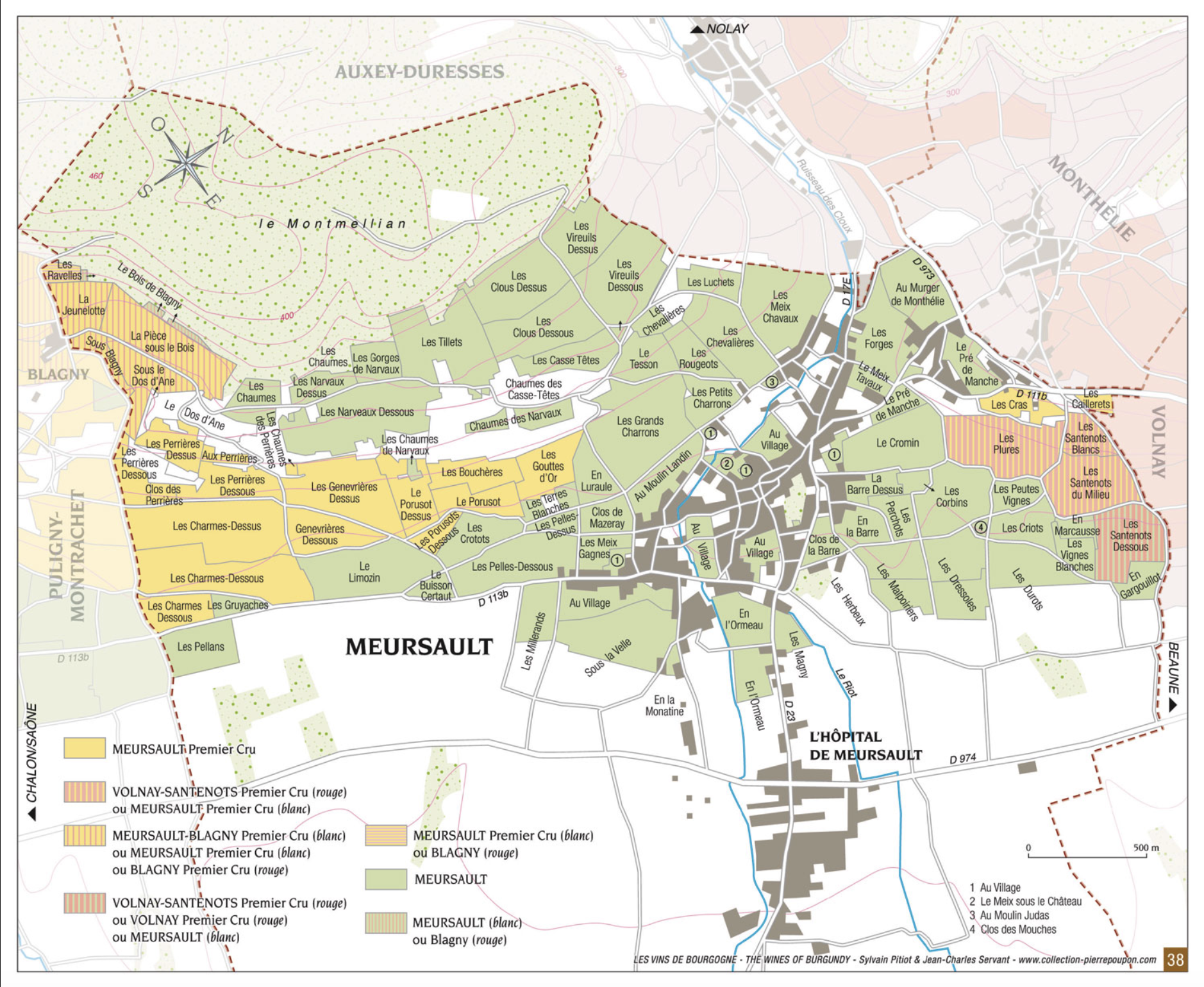
The White Village of Meursault
98% of Meursault’s production is white wine. Whilst it has no Grand Cru’s. It has a cluster of Premier Cru’s next to Puligny-Montrachet and a second cluster next to Volnay.
The Appellation used to describe the wines depends on the variety, Pinot or Chardonnay, and the adjacent Appellation. For example, the cluster next to Volnay uses the Appellation Volnay-Santenot for the red Premier Cru’s. This makes sense when you consider the reputation for reds from Volnay. Whites from the same area use Meursault Premier Cru.
The key on the map details all of the different naming conventions. (Wine Decoded)
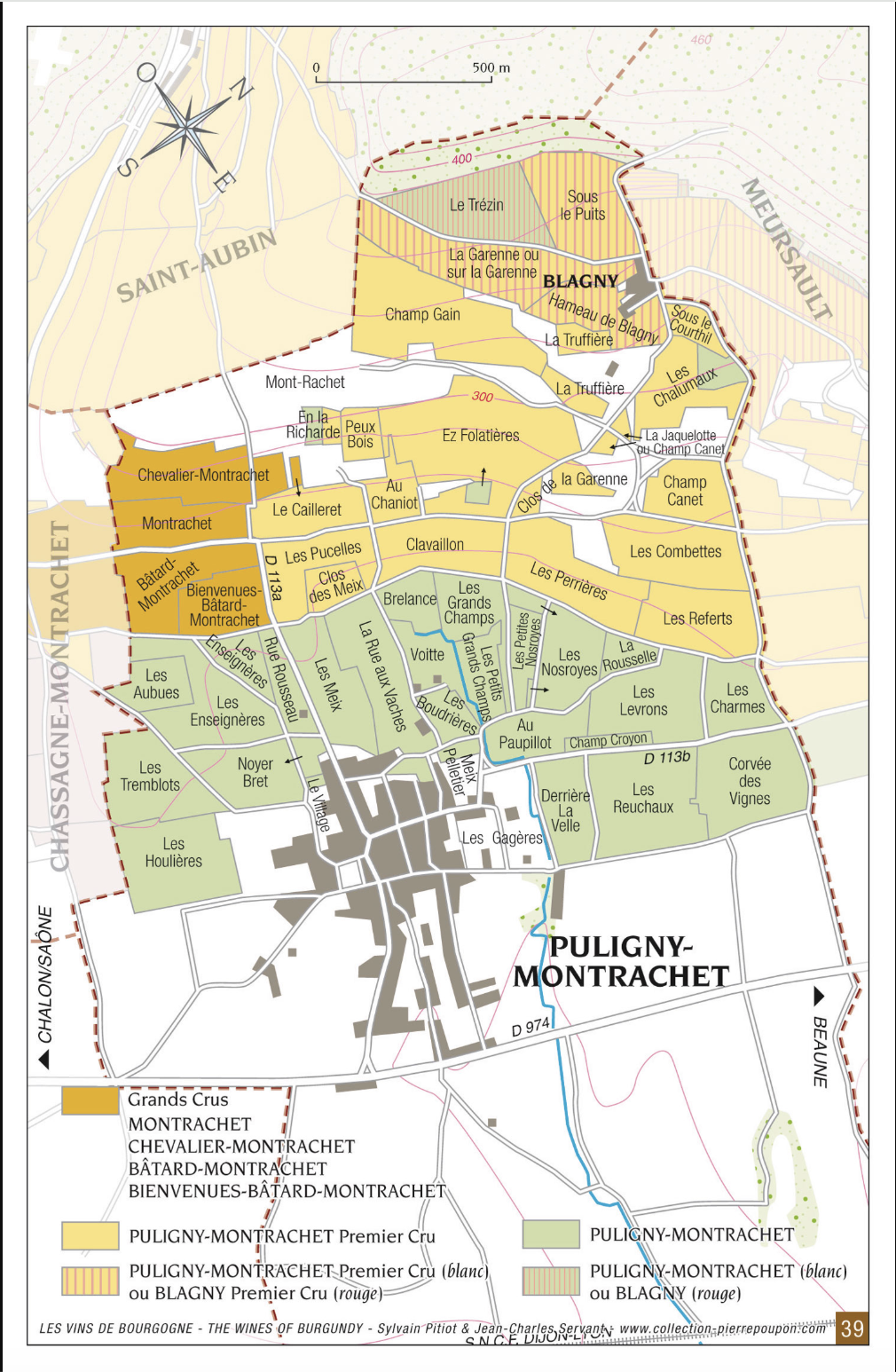
The Village of Puligny-Montrachet
The whites of Puligny tend to be more linear, and, structure with lovely mineral acid.
4 Grand Cru’s: Montrachet & Bârtard-Montrachet, both shared with Chassagne. Bienvenue-Bâtard-Montrachet and Chevalier-Montrachet, both residing fully in Puligny.
There are 19 Premier Cru’s in Puligny with about 1.2% producing red wine. The best known Premier Cru’s are Les Pucelles and Champ Gain, both resting adjacent to the Grand Cru’s.
(Wine Decoded)
“White Burgundy reaches its pinnacle in Puligny-Montrachet. Home to three of the best grands crus—Montrachet, Chevalier-Montrachet and Bâtard-Montrachet—and a number of excellent premiers crus, Puligny-Montrachet fields the most refined and elegant whites of the three famous contiguous communes planted to Chardonnay, Chassagne-Montrachet and Meursault being the other two.”
Bruce Sanderson, Wine Spectator
The Domaines
-
Renowned and respected as one of the finest producers in Burgundy, Bouchard Père et Fils has truly become an institution, known for the exceptional quality of their wines and the diversity of its many vineyards.
Founded in 1731, Bouchard Père et Fils has built up an estate of 130ha and, collectively, is the largest owner of Grand Crus (12ha) and Premier Crus (74ha) across the Côte d’Or Bouchard Père et Fils represents almost one hundred ‘climats’ or uniquely diverse vineyards, including prestigious monopoles such as ‘Beaune Grèves Vigne de l’Enfant Jésus’ and ‘Chevalier-Montrachet La Cabotte’.
(Wine Decoded) -
The hamlet of Blagny, located on the slope overlooking Puligny-Montrachet, has been inhabited since Gallo-Roman times, as evidenced in the numerous fragments of Gallic tiles discovered in the "les ravelles" area.
The Blagny terroir, which measures no more than 40 ha in size, actually contains 20% of the "1er cru" appellations of the communes of Meursault and Puligny-Montrachet, universally known for the excellence of their white wines. The soil, made up of marl clay-limestone, is as suitable for reds as for whites. Grouped around the hamlet of Blagny, our vines are situated in the highest part of the Premiers Crus.
THE VINES OF THE ESTATE ARE ALL WITHIN THE BLAGNY TERROIR
Vineyards planted with white wine varieties in the commune of Meursault benefit from the Meursault-Blagny appellation.
Vineyards planted with white wine varieties in the commune of Puligny-Montrachet fall under the Puligny-Montrachet, Hameau de Blagny appellation.
Vineyards planted with red wine varieties in the commune of Meursault fall under the Blagny, sous le dos d’âne appellation.
(chapelledeblagny.vin/en/our-terroirs)
-
“Domaine Henri Germain might well be Meursault’s best-kept secret. This is a superb source for classically balanced, artisanal white Burgundy that’s built to age, and the softly-spoken Jean-François Germain is justly one of the village’s most well-respected vignerons.”
William Kelley, The Wine Advocate
“I have been saying it for years but I will say it again: if you don’t know these wines, you should because the quality is just too good to ignore.”
Allen Meadows, BurghoundSince Germain remains comparatively under the radar, it’s worth reiterating that viticulture here is organic and vinification decidedly traditional, the wines spending two winters in barrel on the lees, if possible without racking and almost invariably without bâtonnage. In the domaine’s cold cellars, alcoholic and malolactic fermentations are protracted, but Germain is content to take his time. The resulting wines are concentrated but incisive, with fleshy fruit but firm structural bones that demand time in the cellar. In the last decade, the style has become a little less austere and reductive, but the domaine remains old-fashioned in the best sense. Considering the quality to be found here, this seven-hectare estate deserves far greater celebrity, and though I suspect Germain isn’t especially interested in seeking out acclaim, it’s sure to arrive sooner rather than later.
In the Vineyard
The Germain methods are very traditional with organic farming and low yields, we don’t have much info, but, given what’s in the glass he must be looking after the vineyard well.
In the Winery
It’s hard to find much about the Domaine’s winemaking practices. At the end of the day it’s what’s in the glass that matters.
However, there are a couple of insights I can glean from the info available. First, it’s clear from the potential alcohols, ranged from 12.5% to 13.5% in white and averaged 13% in red in the warmer 2018 vintage, that Jean-François’ vineyards yield flavour ripe fruit at this level, and he is picking to retain freshness and natural acidity. We should see reflected beautifully in the glass. Jean-François specifically spoke to the low pH and high natural acidity in his wines; there’s loads of science behind this, you can read about some of it in the Wine Bites Magazine article: Q&A with Paul: “Do winemakers need to add tartaric acid to keep it fresh and age-worthy?”
Second, Jean-François spoke of the long slow ferments at the domain, noting that many were still going 10 months into élévage. In a commercial winery a white wine fermented using cultured yeast instead of wild yeast will finish its ferment in a few weeks. Typically new world winemakers often get stressed out of their minds if ferments take much longer than this. However, over time with greater use of wild yeast in the new world, we’ve grown more comfort with longer slower ferments.
Alex Moreau of Domaine Bernard Moreau et Fils, Chassagne-Montrachet, Burgundy joined me at Yering Station for the 1999 vintage. I can tell you one thing, diversity definitely leads to inspiration and creativity, particularly when you throw a young, motivated, thought leader with real world experience like Alex into the mix. What do you do with such an asset? Easy, you unleash them on some decent fruit, sit back and watch. When you’ve got 1400T of fruit to play with, what have you got to lose! Alex did a mini-experiment dragging out the ferments of 4 barrels of Chardonnay over just a couple of months. The end result? A build in mid-palate depth, a trait that differentiates good Chardonnay from great Chardonnay, presenting a more complete and even mouthfeel.
When I see long slow ferment from a European maker, thinking of this time and the impact on the wine takes me to a happy place.
Where in the World is Domaine Henri Germain?
Germain is based in Meursault with fruit coming from Chassagne-Montrachet and Beaune.
(Source: Wine Decoded)
-
Domaine Leflaive takes centre stage in the pantheon of truly great white Burgundy producers. Allocations of Domaine Leflaive are hard to come by and securing them on release is very advantageous.
Domaine Leflaive is the most prestigious winery in Puligny-Montrachet, boasting a supreme portfolio of vineyard holdings, including five hectares of 1er Cru and 13 acres of Grand Cru. The Domaine heralds from 1717, yet the family line traces back to Joseph Leflaive (1870-1953), an engineer who worked on the first French submarine. In 1905, Leflaive was able to buy 25 hectares at a very low price, due to the widespread vineyard decimation caused by the phylloxera epidemic. In 1920, Leflaive began a replanting programme with better adapted root stock. After Joseph’s death in 1953, his son’s Vincent and Jo cemented the Domaine’s reputation as one of the leading estates in all of Burgundy. In 1973 the brothers restructured the Domaine as a company to avoid splitting it up in adherence to French inheritance laws: the Napoleonic law of succession is largely responsible for the large fragmentation of vineyard plots throughout the region.
In 1990, Vincent’s daughter Anne-Claude Leflaive and her Cousin Olivier Leflaive began running the Estate. Olivier assumed responsibility for running the negociant business and as such in 1994, Anne-Claude took over the running of the Domaine. In 2009, Olivier lost the holdings, which are now separately known as Olivier Leflaive, Domaine Leflaive however, remains more sought after and greater prized. After the untimely death of Anne-Claude Leflaive in April 2015, the estate is now being managed by Brice de la Morandiere who is Anne-Claude’s nephew and great grandson of Joseph, with the winemaking under the control of Eric Remy.
In 1997 after seven years of experimenting with one third of the Domaine biodynamic and two thirds organic, she decided to transform the Domaine to completely biodynamic methods. This mirrored the footsteps of Lalou Bize-Leroy and Nicolas Joly, who believe herbicides and fertilisers cause long-term damage to the soil. The wines are aged for 12 months in 25% new French oak and then moved to steel tanks allowing the wine to clarify over a second winter of ageing and integration.
Leflaive boast spectacular 1er Cru parcels in Les Pucelles, Folatieres, Les Combettes and Le Clavoillon. Le Clavoillon borders Les Pucelles in the central limestone and marl escarpments of the village, Puligny-Montrachet, which runs through the middle of Montrachet and Batard-Montrachet and as such shares much of their characteristics.
-
Domaine Jean Monnier is a long-established family estate based in Meursault in Burgundy’s Côte de Beaune, with a history dating back to the early 18th century. The domaine farms vineyards across several well-regarded appellations, but is particularly recognised for its Meursault Chardonnays, which have built a strong reputation for reliability and balance.
Monnier’s Meursault wines are sourced from mature vines on classic limestone and clay soils and made in a traditional style that prioritises structure and clarity over excess richness. Oak is used carefully to support texture rather than dominate, resulting in wines that show ripe stone fruit, natural acidity and the ability to develop with time. These Meursaults are regularly well regarded in international tastings and competitions, reinforcing the estate’s standing as a dependable source of white Burgundy.
-
Our Domaine was established in 1980, when Fabienne Coffinet and Michel Morey married, bringing together the vineyards inherited from Cécile Pillot and Fernand Coffinet, Fabienne's parents, and those passed down from Madeleine and Marc Morey, Michel's parents.
The young couple, who had just welcomed Florent, their eldest son, began their own chapter in the family winegrowing adventure: a year later, their first vintage was born, as was their second child, Thibault.
A sign? Maybe... He joined our small team in 2000, driven to uphold the identity of our terroirs. He understands the ongoing importance of attuning to the land, pushing its limits, and adjusting to sustain the essence of our Domaine: unveiling lively wines, tailored for aging, and imbued with the essence of the nature that has shaped them.
Small bottles that tell the story of their origins:
Encompassing nine hectares, our vineyards comprise some of the finest terroirs for exceptional white wines in the Côte de Beaune, including the Premiers Crus La Romanée, Dent de Chien and Blanchot-Dessus in Chassagne-Montrachet, and the renowned Grand Cru Bâtard-Montrachet. Although 80% of our clay-limestone plots are planted with Chardonnay, neither have we forgotten the other king of Burgundy: Pinot Noir.
In every bottle, we strive to encapsulate the essence of these exceptional terroirs: an authentic, pure, unadulterated expression. Thus, the pursuit of maturity is obvious. As a result, since 2021, the vines of our most prestigious appellations have been plaited and then ploughed with horses. Without pruning, the plant comes into its own. It infuses its berries with extra energy.
In all our vineyards, the return to traditional Guyot-Poussard pruning ensures a deeper respect for the flow of sap. This method channels all the vitality of the soil into the future grapes. Later, through meticulously disbudding and leaf thinning, we enhance our natural prevention of disease and rot. The handpicked bunches are rigorously sorted. The result of this constant attention? Ripe, perfectly healthy berries. The promise of delightful emotions.
Let the expression of our plots make the difference
Terroir over technology: that's our ambition. With minimal intervention, we aim to let the balance of our grapes take centre stage: a harmony that unveils itself in the youthful character of our wines, maturing into peak aromatic complexity after a long rest in the cellar.
To ensure our vintages gracefully evolve over time, we refrain from using sulphur upon harvest. The grapes are pressed meticulously to extract the valuable natural antioxidants present in their stems and seeds, just as Thibault's grandfathers used to do. Subsequently, the must is racked for 48 hours to preserve as much of its essence as possible, while excluding any elements that might impart herbaceous aromas.
Next comes the ageing period, which occurs in 350-liter oak barrels. For each bottle, we carefully select barrels from four different coopers based on the desired origin and toast level, and we adjust the ratio between new and old barrels accordingly. The vaults of our magnificent cellars, constructed in the 16th century by the monks of Citeaux, also house amphorae and egg-shaped vessels. These containers, which accentuate the saline influence and freshness of our terroirs, are incorporated into our cuvées. Because here, as at every stage of our work, balance is our watchword...
(Morey-Coffinet Official)
-
Burgundian vineyards are so expensive that no day to day person can afford them. When Phillipe Pernot and his new wife, a Belicard, wanted to establish their own label after working with his father for many years, her parents gave them her inheritance early with about 6ha of Bourgogne, Villages and then five Premier Crus in both Puligny-Montrachet and Meursault. Modern, minerally – though with plenty of body – delicious in every price range. As one reviewer said, “the best White Burgundies you never heard of.” Philippe is a genuine, gifted and hardworking Puligny Montrachet vigneron and winemaker. In each instance his wines are amongst the finest available, and whilst not cheap, remain very good value for money given the quality.
This small six-hectare domaine located in the heart of Puligny-Montrachet is making rapid strides. Philippe Pernot (a scion of the Paul Pernot dynasty) launched the Pernot Belicard label in 2009, gradually selling less and less to the négociants. In the vineyards, he cultivates the soils, de-buds aggressively and takes pains to retain his old vines in good health. The grapes are harvested by hand, with Philippe typically among the earlier pickers in the village. Since 2014, there's more sorting, the grapes passing over a shaker table before being whole cluster pressed. Initially, the wines were bottled to make room for the new vintage, but Philippe, evidently an enquiring mind, felt that something was missing: now, the wines stay in barrel until August, but spend an additional three to six months in temperature controlled stainless steel tanks with the fine lees. The result, he contends (and I concur), are wines that are more integrated and complete. These are already very good wines, and Philippe possesses some enviable parcels, but it is his desire to refine and improve that marks this out as an estate to watch.William Kelley, Robert Parker's Wine Advocate.
-
“Philippe Chavy took over the reins of this wealthy Domaine from his father in 2002 with a little more than 3 hectares of prime sited vineyards.
The Domaine now extends to just over 8 hectares, with some thirty individual parcels scattered throughout the neighbouring villages of Puligny Montrachet (from his father’s side of the family) and Meursault (through his maternal side). … Philippe has followed the cycles of the lunar calendar when determining work in the vineyards and cellars.” Alliance
Based in Puligny-Montrachet, Domaine Philippe Chavy has been farming vines across the Côte de Beaune for nearly a century. The majority of the estate’s Puligny-based vines were planted by Philippe’s father during the 1950s, though the property’s oldest vines in Meursault date back to 1932.
Today, Domaine Philippe Chavy comprises a total of eight hectares of vines spread across 30 plots and 14 appellations, and are planted to Chardonnay, Aligoté, Pinot Noir, and Gamay.
Under Philippe’s oversight, all use of herbicides and insecticides has been eschewed at the domaine, so as to preserve the terroir and encourage natural biodiversity amongst the vines. All fruit is picked by hand and meticulously cared for during the entire growing cycle—in the words of Philippe, “no good wine can be made without sound grapes.”
In the cellar, fermentations take place in temperature-controlled stainless steel tanks, as freshness and acidity are of utmost importance. All Chavy wines mature in oak barrels of various ages and undergo regular lees stirring prior to being bottled in conjunction with the lunar calendar.
Currently, Philippe has two full-time employees that help him in the vineyards and cellar year-round. His wife, Graziella, handles all aspects of sales and administration.
“I am fortunate enough to live and work in the heart of one of the most prestigious Chardonnay vineyards in the world,” says Philippe. “Each and every vine and the grapes they yield command respect. It is my daily task to enrich this inheritance just like my parents and grandparents when they started.”
The Wine List & Menu (TBC)
First Bracket
2021 Jean Monnier Puligny Montrachet
2023 Philippe Chavy Corvées des Vignes Puligny-Montrachet
2022 Jean Monnier Meursault Les Rougeots
2023 Philippe Chavy Meursault
More green than yellow in colour. An attractive nose, not especially in the rounded Meursault style. Once again, the style is on the elegant side, but with some concentration at the back. Ripe citrus notes throughout. A little new wood in the mix.
89-91 points, Jasper Morris, Inside Burgundy
Second Bracket
2023 Philippe Chavy Rue Rousseau Puligny-Montrachet
More lime than lemon in colour. A little more stuffing on the nose, more ample than Corvee des Vignes. Certainly, Rue Rousseau delivers more body, backed by a little oak, one can see that this lies a little further up the slope towards the crus. Fine length with a little grip at the finish.
90-92 points, Jasper Morris, Inside Burgundy
2022 Chapelle de Blagny Meursault Ravelles 1er Cru
This wine has a lot going on, from lemon curd, smoked citrus peel, fleshy mandarin, gentle toastiness from the oak, vanilla pods, and hawthorn flowers. The texture goes hand in hand with the juiciness of that slurpable pulpy citrus and white nectarine. Finesse and balance are the keys to this wine. This is not the usual Meursault that slaps you on the face with its power; rather, it is more ethereal.
96 Points - Lisa Cardelli, WinePilot
2023 Domaine Henri Germain Meursault 'Les Chevalières'
The 2023 Meursault Les Chevalières (not Premier Cru as I mistakenly wrote last year!) has a very cohesive bouquet with light white flower and waxy aromas. It's more mineral-driven than the Meursault Village. The palate is beautifully balanced with a fine bead of acidity. It's fresh and saline with a touch of spice on the finish. So composed, this might be even better than the impressive 2022. It is outstanding.
92‑94 points, Neal Martin, Vinous
Third Bracket
2022 Chapelle de Blagny Puligny-Montrachet Hameau de Blagny 1er Cru
2023 Philippe Chavy Puligny-Montrachet Les Pucelles 1er Cru
13% on the nose. More lemon than lime in the colour. More backward than Folatières, but more complex, in bouquet. A little stricter and more structured, with adequate intensity. A few waves of flavour backed by correct oaking, with a fine long finish. His two plots are well situated, higher up.
92-95 points, Jasper Morris, Inside Burgundy
2015 Morey Coffinet Puligny Montrachet Les Pucelles 1er Cru
This too is quite firmly reduced today though again it will probably eventually dissipate. As one might reasonably expect, the nicely concentrated middle weight flavors are notably finer though not nearly as imposingly scaled, all wrapped in a sappy, complex and beautifully persistent finale. The natural class of a fine Puligny is in evidence and this should drink well young but age well over the mid-term.
92 points, Allen Meadows, Burghound
Fourth Bracket
2023 Philippe Chavy Meursault 'Charmes' 1er Cru
Mid lemon and lime. The nose is a little blocked by sulphur, but that is temporary. The volume expected of a Charmes is certainly there, the wine delivers all that one would want. The detail remains a little hidden but the sense of correctly ripe fruit backed by adequate acidity, suggests a Charmes which will develop as it should. Plenty of reserve here.
92-94 points, Jasper Morris, Inside Burgundy
2022 Pernot Belicard Meursault Perrieres 1er Cru
The 2022 Meursault Les Perrières 1er Cru has a strict, malic bouquet that veers toward Puligny in style; there's a fine sense of energy here. The palate is very well balanced and harmonious, with beautifully integrated oak—lightly spiced, with touches of grilled walnut on the finish. Excellent. Tasted at merchants' 2022 Burgundy tastings in London.
93 points, Neal Martin, Vinous
2023 Domaine Leflaive Meursault Sous le Dos d'Âne 1er Cru
An all but imperceptible application of wood sets off vaguely exotic aromas of mostly petrol, white peach and a floral top note. There is a bit more volume and richness to the attractively tension-filled middle weight flavors that are at once generous yet precise, all wrapped in a youthfully austere, persistent and balanced finale that is also going to need at least a few years of cellaring first.
90-92 points, Allen Meadows, Burghound
2013 Bouchard Pere & Fils Meursault-Perrieres 1er Cru
Discreet nose hints at white flowers, rose petal and white pepper, with citrus peel in the deep background. Fine-grained and aromatic in the mouth, offering an intriguing blend of sweet and peppery elements and wet-stone minerality. Finishes classically dry and long, with soil-driven smoky, saline minerality.
91-93 points, Stephen Tanzer, Vinous (IWC)