

Power, Perfume and Pinot:
Gevrey-Chambertin and Chambolle-Musigny
Join us at Lamont’s for an evening of exceptional red Burgundy, thoughtful conversation and a closer look at two of the Côte de Nuits’ most celebrated villages: Gevrey-Chambertin and Chambolle-Musigny.
12 Red Burgundies from 11 Domaines
Aurelien Verdet | Bruno Desaunay-Bissey | Comtes Georges de Vogüé | Confuron Cotetidot | Denis Mortet | Domaine des Beaumont | Domaine Faiveley | Domaine Fourrier | Drouhin-Laroze | Humbert Frères | Marchand & Burch
Across 9 Vintages…
2008, 2009, 2010, 2011, 2017, 2020, 2021, 2022, 2023
“Gevrey-Chambertin is arguably the most classic Burgundian expression of Pinot.”
Clive Coates MW, Decanter
Sunday, July 12th
Hosted by JJ and Yasmeen Jansen MW (TBC)
Lunch: 12–3pm, 12 wines and 4 courses, $395
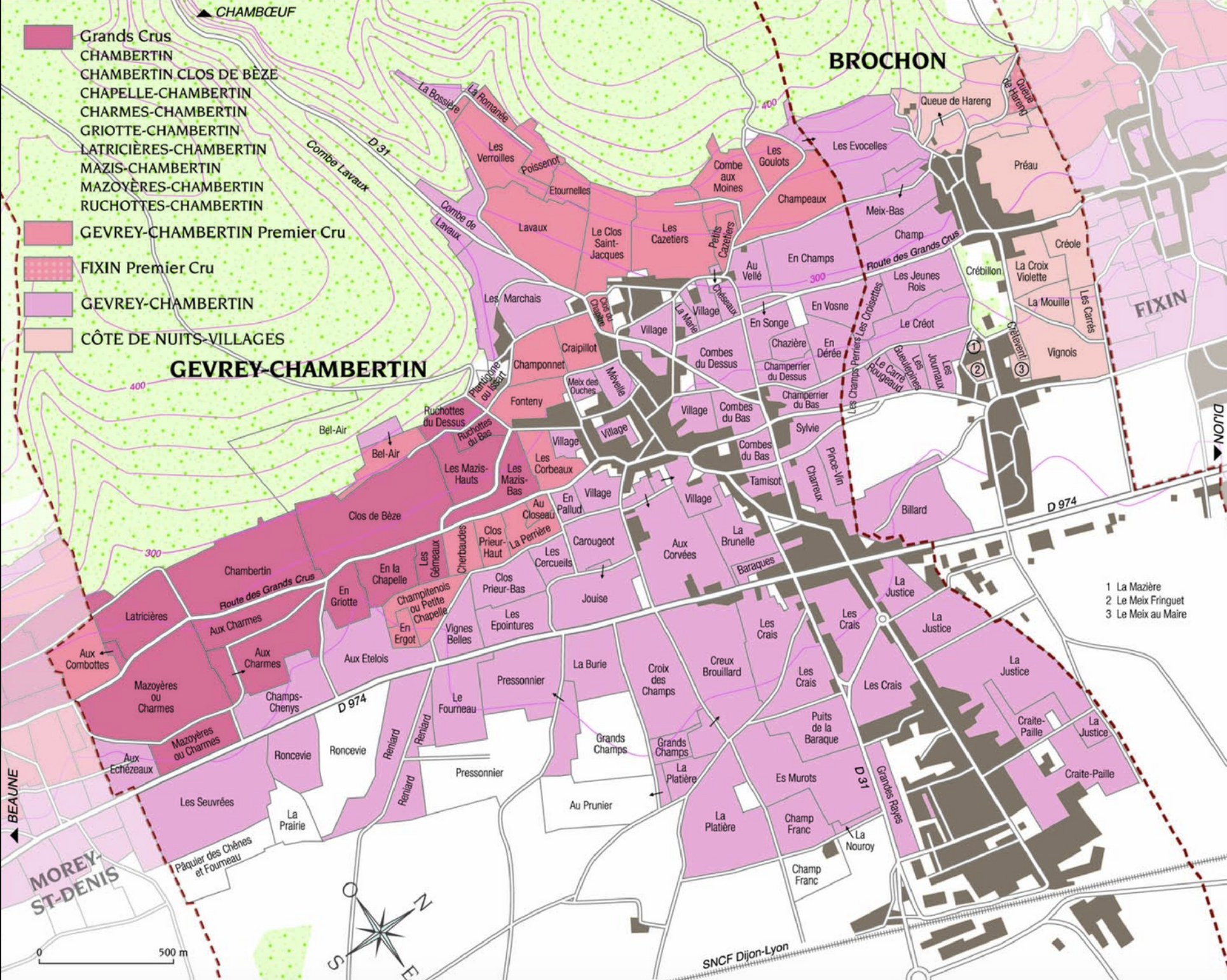
The Villages of Gevrey-Chambertin
When asked to describe the appellation, Nicolas Rossignol, of Domaine Rossignol-Trapet, summarised Gevrey-Chambertin in three words: Prestige, Pinot Noir and Power.
Gevrey-Chambertin lies 15km south of Dijon in the Côte de Nuits. The region takes its name from the village, Gevrey, and the appellation’s most prestigious vineyard, Le Chambertin. This village-vineyard naming convention is commonplace today, however, Gevrey-Chambertin set the trend, officially linking the two in 1847.
Covering approximately 550 hectares, it is one of the largest appellations in the Côte d’Or and certainly the largest appellations for reds; Pinot Noir is the only variety planted in Gevrey-Chambertin. Due to its size, the sub-region has a variety of terroirs – from gravels in the Vau de Combe to rich clay-soils on the norther côte – and produces a diversity of styles. Traditional viticultral and winemaking predominate, however, there has been growing trend towards more organic practices over the past two decades.
Gevrey-Chambertin has earned a reputation for producing Pinot Noirs with rich fruit and structured tannins. The best expressions see this intensity tempered with elegance, yielding concentrated wines with complexity and finesse.
(Wine Decoded)
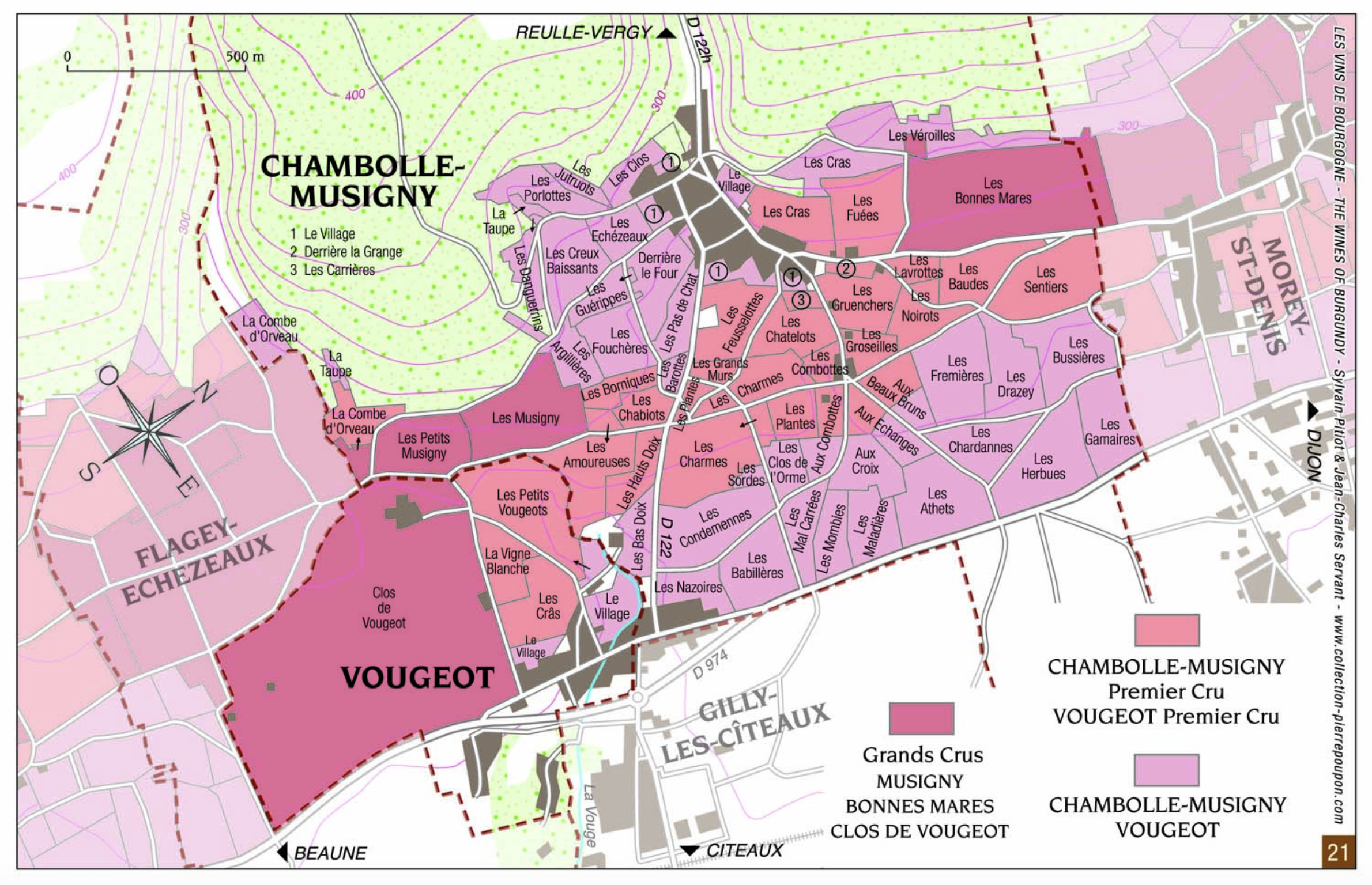
The Villages of Chambolle-Musigny
On the southern border of Morey-Saint-Denis lies the appellation of Chambolle-Musigny. Its AOC status dates from September 1936, making it one of the first French vineyards to be designated.
Like Gevrey-Chambertin, Chambolle-Musigny is completely planted to Pinot Noir. However, the styles associated with the respective appellations present an intriguing contrast. Where Gevrey-Chambertin has a reputation for powerful, structured Pinot Noirs, Chambolle-Musigny typically offers more delicate expressions. This is not to suggest that Chambolle-Musigny is a wilting violet; rather its intensity manifests in more subtly, with soft tannins and pretty aromatics.
Chambolle-Musigny is home to two superb Grands Crus: Bonnes-Mares, which links its vineyards to those of Morey-Saint-Denis, and the great Musigny vineyard, which overlooks the Clos de Vougeot. The village also boasts among its fine wines the prestigious Premier Cru, Les Amoureuses.
The appellation’s sloping vineyards face east at altitudes of 250-300 metres with only a shallow covering of soil overlying the parent rock, but fissures in the hard Jurassic limestone allow the roots to seek nourishment deep within the sub-soil. Boulders and gravels in the valley bottom ensure good drainage.
(Wine Decoded)
The Domaines
-
Still flying under the radar, Aurélien Verdet’s Burgundies not to be missed. The purity and personality of the Pinot Noir demonstrates just how well he adapts to every vintage, reflecting the style of the season. His cellars are tucked away in the quiet village of Arcenant in the Hautes-Côtes de Nuits
and keeps a fairly low profile; he prefers to spend his time in his organically farmed vineyards. Father, Alain, planted the vineyards in 1971 and farmed them organically from the start, making them possibly the oldest organic vineyards in Burgundy. He has a range of excellent premiers crus, including contracts with vineyards across the Côte de Nuits. Aurélien’s wines offer
refreshingly good value.
Laywheeler.com
After having studied with David Duband, Aurélien Verdet decided to take over the family estate in the Hautes Côtes de Nuits, and rather with some success. Inspired by the principles of organic viticulture, pioneered by his father in the 1970s, he produces high quality wines in all humility and with admirable panache. This talented young winemaker enchanted us with his kindness and the quality of his wines. All is well ! A beautiful domain full of future!
Mathieuvins.ch
Aurélien Verdet embodies this new generation of talented winemakers who chooses to fly under the radar. We suspect that his wines won’t remain hidden gems for long.
Vinosophy.comAurélien Vedret is a vigneron who inherited from his father not only the cellar, but above all the passion for organic farming and a respectful vinification of the product. Fermentation takes hold thanks to indigenous yeasts, the use of sulphites is moderate and the aging in wood takes place in Burgundy oak barrels with wood from Tronçais and Vosges.
Terlato.com -
How does a superstar producer remain under the radar? In a globalised world of instant communication, how can a great winemaker remain little-noticed?
Welcome to the world of Bruno Desaunay-Bissey – for decades one of Burgundy’s greatest producers, who’s only recently coming to general acclaim.
Making wines from a scattering of holdings located right across the most famous appellations of the Cote de Nuits, Domaine Desaunay-Bissey’s wines offer some of the regions greatest value. However, they are now beginning to come to world wide notice, and the most sought-after wines are available only on allocation.
Desaunay-Bissey’s comparative lack of fame isn’t due to the quality of the domaine’s vineyards, which consist principally of old vines sited in the best parts of Vosne-Romanée and Echezeaux, including some planted as far back as 1928. Remaining in the family ever since, Bruno has been producing wine from these plots since 1975, farming without pesticides, and practising minimal-intervention winemaking.
It certainly isn’t the wines, which are pin-point-precise and true to their terroir, yet exquisitely fruit-forward and easy to appreciate. They’re the kind of wines you might find on the list in a local restaurant in Burgundy and order without any great expectation, before having your mind blown by an all-time-great wine experience.
Unfortunately Bruno passed away in 2023 and now we see his son Richard taking over the Domaine.
The 2022’s are a very late release because of Bruno’s passing, The French government froze all assets till all affairs of the Domaine were legally passed on to Richard. Hence, we can only offer the 2022’s now. Wow! What a way to begin as the new winemaker. These are without doubt some of the finest under the radar wines in Burgundy…
musigny.wine/vine/bruno-desaunay-bissey
-
Many domaines in Burgundy can trace their roots back over 100 years, though since the majority of the vineyards were owned by the church and aristocracy until ~1790, only a handful of domaines can claim more than 200 years of history. The Domaine Comte Georges de Vogüé, however, can trace a line back over 550 years to ~1450 and the Chambolle vines of one Jean Moisson (as above). Today it is the 20th generation of the family that head the domaine; Claire de Causans and Marie de Ladoucette, the granddaughters of the late Comte Georges de Vogüé (1898-1987) who is pictured right. Comte Georges took over from his father Arthur in 1925, changing at that time the name of the domain from Comte Arthur to Comte Georges, though from around 1980 Comte Georges’ daughter, Elizabeth, took ever greater responsibility. Following the death of her father, it was she that decided to put a new team in place; Gérard Gaudeau tended the vines, though today that position is held (since 1996) by Eric Bourgogne – a most fitting name – Francois Millet was made responsible for the winemaking at the retirement of Alain Roumier, and in 1988 Jean-Luc Pépin, ex Domaine Joseph Drouhin, became responsible for the sales. For a short time before the arrival of Jean-Luc, Elizabeth’s son-in-law Gérard de Causans, husband to Claire, took the rôle of finance and sales, but was sadly cut-down in his prime by terminal illness
De Vogüé and family Roumier – For many, many years a Roumier was instrumental in the work of the domaine. Alain Roumier was the régisseur for the domaine during the time of Comte Georges, as apparently was his father and grandfather before him. As reported by Robert Parker, it was Alain Roumier who famously suggested that if the wines of the seventies and eighties were not quite as good as before, then blame “Americans’ obsession with brilliant, clear wines” and the subsequent need for the domaine to filter. Of course, this being a family affair, it wasn’t just Alain that was involved; study the photo above of Comte Georges, and the man in the outsize beret and glasses to his right is Georges Roumier, uncle of Christophe from today’s Domaine Georges Roumier.
Working the vines – Eric Bourgogne walks you through the vineyards talking of the domaine’s philosophy; they practice ‘lutte raisonée’ (reasoned battle) which is effectively intervention only as required rather than treatment as prevention. Eric points out that in the challenging 2004 vintage (hail, oïdium, rot) they only sprayed six or seven times, most biodynamic domaines would have made double that number of treatments. In common with most domaines in Chambolle they also practice ‘confusion sexuelle’ – these are the small brown tags of insect pheromones that you see on the end of the rows of vines. Eric believes that a balance of insects is best, as treatments against one insect type will often have negative consequences for beneficial predators. Across the domaine Eric uses three types of pruning; Guyot, Cordon Royat and for the young vines a formation pruning.
Within Musigny, they now allow the weeds and grass to grow between the rows throughout the autumn and winter, ploughing by horse from Spring onwards, they use no weed killer. Eric believes that these choices result in less-compacted soil and significantly less erosion than the domaine used to experience. The domaine puts their own compost on the vineyards at a rate of 2 hectares per year, this translates to an addition of compost every six years. It’s very interesting when you look up the rows in Le Musigny, despite no difference in treatment, the grass between the rows suddenly stops as the vines change from mature pinot to young chardonnay. Something to do with shallow roots and less soil? – Who knows…?
A whiff of controversy – It comes with the territory; like Domaine de la Romanée-Conti and to a lesser extent also Domaine Leroy; the high prices asked for the wines set a certain level of expectation, add into the mix the overwhelming ownership of one of the most gifted terroirs and expectation is exponentially greater. As Matt Kramer said (Making Sense of Burgundy, 1989) the wine should “deliver the exhilaration one has a right to expect from Musigny”. In some ways it is even tougher for de Vogüé as there are other Musignys around to provide a benchmark, anyway we shouldn’t feel sorry for the domaine as they are in a fortunate and responsible position: It is, however, precisely because they are in such a position that so many people feel the need to pass judgement – some informed, some not. Today at least, if something needs to be done, it is done. The perfect example is what they did in 1991; a localised hail-storm ripped through Musigny, heading north until it stopped on the border with Morey St-Denis. Francois Millet’s quick pre-harvest vinification of the Musigny showed the taste of hail, so sixty people were used (it is said with tweezers) to remove every single damaged grape, and what a clean wine it is today.
Almost all commentators talk of a mid-1970’s to mid-1980’s dip in quality, so no smoke without fire but some seem reticent to accept that the ‘old quality’ – whatever that means – could once more be found in the wines of today. The 1990 Musigny is an interesting example: those that tasted from barrel saw greatness, those currently tasting from bottle are often underwhelmed, calling the wine Bordeauxesque. Without saying so directly, Francois Millet gently chides those that comment on the wine today, saying that ‘only those who tasted from barrel, know the true potential of that wine’. I find myself drawn to his viewpoint; all those great Musignys of the 40’s, 50’s and 60’s were proclaimed great when they were 30+ years old, the 1990 has plenty of time before it needs to ‘deliver’.
Summary – I think it is quite fair to comment on the constituent parts of young wines and indeed what we believe the future might hold for them but the real truth will be available to all only once they reach maturity. I see an exemplary quality to the domaine’s wines but there is also a linearity, a haughtiness, a slight lack of ‘warmth’ if you prefer. However you wish to describe it, relative their peers, there is a lack of charm in these young wines. I stress young, because the 1993 villages and the 1992 Amoureuses show both charm and character, perhaps then, it really is just a question of time. If that is the case, then an equally important question is: how do you know when the time is right? Both Francois and Jean-Luc are happy to emphasise – call and ask us – they keep enough half-bottles to test the wines from each vintage on a regular basis. I really should try and visit next time they open their 1990s…
It is never cheap to produce the best wine possible, that said, the domaine’s wines have always been priced above most pockets. I believe that in the 1990s the wines excel in the context of each vintage but if you consider that an average 1993 is significantly better than an average 1992 or 1994 then it’s also possible to point to a spectacular lack of value in ‘lesser’ vintages, but I’m convinced that they are worth every penny in the good vintages – which happens to be most of the last 15+ years. I’m sure my 1999’s could outlive me, though of course, I’d be disappointed if they had the opportunity…
The Burgundy Report -
Brothers Yves and Jean-Pierre Confuron have carried on the traditions at the historic Domaine Confuron-Cotetidot that would certainly make their ancestors proud; the family continues to lead the way in séléction massale as it has since the 17th century, and even boasts a clone of the noble Pinot Noir in their name. The domaine remains one of the rare few to produce four village wines among 11 hectares in Burgundy’s prestigious Côte de Nuits (Nuits-St-Georges, Vosne-Romanée, Chambolle-Musigny and Gevrey-Chambertin), in addition to a number of premier cru and grand cru sites. Today, Yves directs the domaine and Jean-Pierre works in the cellar, while their parents Jacky and Bernadette work the vineyards as carefully as they have for more than fifty years. The success of the house style has earned the two respected roles as consultants to neighboring estates as well. Theirs is old-school red Burgundy at its best.
That the land has never seen synthetic herbicides or pesticides distinguishes Domaine Confuron-Cotetidot from the bulk of their peers in Burgundy, where more holistic vineyard practices can be a challenge. While they incorporate organic practices into their farming, they are not interested in being tied down by the strict confines that certifying agencies dictate. Regular plowing and short pruning (with an occasional green harvest) keep yields low, between 35-45 hl/ha, on what are generally very old vines. Harvests are always later than most to insure ripe stems. The grapes are then fermented in whole clusters, undergoing long cuvaisons of 2 to 3 weeks, and extended barrel-aging up to 2 years. New oak levels range from 10-20% in the village wines and up to 50% in the grand crus. Bottled unfined and unfiltered, the wines display incredible aromatic intensity, spicy fruit, and an elegant minerality from their exceptional terroirs.
beauneimports.com
-
Our wine estate has always been comprised of a multitude of plots of vines.
Historically, Charles MORTET begins in 1956 with one hectare of vines. When my father Denis takes over from him in 1992, the estate is made up of 4.5 hectares in the villages of Gevrey-Chambertin, Chambolle-Musigny and Vougeot. In 1993, Denis and Laurence, his wife, take over an estate of 4 hectares including plots of First Growth Lavaux Saint-Jacques, Village plots situated En Motrot, Au Vellé and En Champs and also a plot in Marsannay in the place named Les Longeroies. In 1997, they buy a plot situated En Combe du Dessus in Gevrey-Chambertin; in 1999, a plot of Chambertin Great Growth and in 2000, a few plots, including En Derée village and few plots of First Growth.
Today, Laurence, Arnaud and Clémence cultivate one hundred plots of vines on a wine estate that stretches from Daix, across the Dijon plateau, to Vougeot.ince assuming the management of the estate in 2006, Laurence and Arnaud have taken over 5 more hectares:
• In 2011: 0.5 hectares in AOC Fixin and a superb plot of Gevrey-Chambertin.
• In 2014: a plot of AOC Bonnes-Mares Great Growth and another in AOC Mazis-Chambertin Great Growth.
• In 2013, Clémence comes to work at the estate.
Clémence and Arnaud establish a new estate in 2016, reaching a new milestone by progressing from 12 to 16 hectares, including:
– Plots in the Village appellation
– First Growths in AOC Gevrey-Chambertin Les Perrières and Lavaux Saint-Jacques
– Great Growths in AOC Charmes-Chambertin and Mazoyères-Chambertin.domaine-denis mortet.com/en/vignoble/
-
The seventh generation of Domaine des Beaumont have merely 5.5 Hectares of vines. There are no ancient and character-filled cellars here. This is one of the few (along with Xavier Durand) of the serious producers who have their cellars on the eastern side of the D974 – main Dijon to Beaune road, which winds through or past all of the great names of Burgundian villages. This is a significant, two storey modern cement structure. The wine style, while structured, is more modern than most and retains fruit freshness and purity as compared to the worked and structured complexity of most in this northern part of the
Cote de Nuits. JJThis domaine has been connected to the vines for 7 generations now, though today there are actually 4 proprietors, as the domaine’s 5.5 hectares of vines are assembled from aunts, grandparents and mothers too. Thierry Beaumont began the current enterprise in 1991, mainly selling in bulk, but from 1999 he began to commercialise bottles from the domaine – within 4 years everything was sold in bottle. Thierry sometimes buys grapes too – mainly in Morey – and at first glance the label is the same, but on closer inspection you’ll notice that it says Thierry Beaumont, not Domaine des Beaumonts – still, Thierry does some of the vineyard work too. Vincent Beaumont is responsible for the commerce. Today, about 60% of the production is exported.
Bill Nanson, Burgundy Report in 2015 -
Quiet little side streets are ten a penny in Burgundy. Lots of Burgundian domaines sit along streets like Rue du Tribourg in Nuits-St Georges, though none of them is quite like Domaine Faiveley. Nothing in Burgundy is quite like Domaine Faiveley.
The vat room is big and bright. Daylight pours in through a massive arched window, framing the vista of vines just outside. This doesn’t feel particularly like Burgundy; you’d be forgiven for thinking you were in one of the better postcodes of Bordeaux or halfway up a mountain in the Napa Valley. Downstairs, the cellar is vaulted ceilings and oak barrels as far as the eye can see. It’s not very Burgundian in scale. Few Bordeaux châteaux have anything of this magnitude; it could be a Champagne House, or something out of the wine world altogether. Not quite the warehouse from Raiders of the Lost Ark, though not a million miles away either.
“In 18 years, I’ve never seen the cellar this full,” says Erwan Faiveley as he shows us around. The 2022 and 2023 vintages here have been generous. Erwan was just 25 years old when he took over the family firm. He doesn’t look a lot older now than he did back then. A little less hair, perhaps, but he has kept a bright, youthful air about him.
In that same time, however, there has been profound change here – and the Faiveley wines of today are in some ways unrecognisable from those of the past.
aiveley family history
Faiveley is an old name in Burgundy, with the wine arm dating back to 1825. Turning the adage about how to make a small fortune in the wine business – you start with a big fortune – on its head, the family later became manufacturers to the railway industry in the form of the multinational Faiveley Transport.
In the early days, Faiveley was a négociant. His ancestors “were buying fruit, making wine and bottling it under our name,” Erwan says. Before long, the downside of relying on other growers became clear – “especially in Burgundy, where the notion of terroir is so important.” To build a lasting legacy, they decided they would have to own their own vineyards; they bought their first plot in 1834.
Over the years the family holdings have grown considerably. With around 120 hectares of vines, Faiveley is among the largest owners of vineyard land in Burgundy today. The portfolio is enviable, with a handful of monopole vineyards including the Grand Cru of Clos des Cortons Faiveley, along with a string of prized Grands Crus, Premiers Crus and village-level vineyards, for both red and white wine. Despite the domaine’s overall size, many of its individual holdings are tiny: the smallest, a microscopic (0.14-hectare) share of Musigny, yields no more than 500 bottles in a good year. They still operate as a négociant, those wines bearing the historic Joseph Faiveley label – and accounting for the equivalent of another 40 hectares of vines.
This puts Faiveley in a rather unique position: it’s bigger than virtually any other domaine, and yet the overall production doesn’t come close to that of the largest négociant houses. The scale is perhaps more Bordelais: Château Lafite Rothschild alone isn’t much smaller than Faiveley’s estate holdings; add sibling estate Château Duhart-Milon, and that one branch of the Rothschild family’s Pauillac holdings alone outweigh Faiveley’s entire domaine and négociant production the length and breadth of Burgundy.
By local standards at least, Faiveley is something of a giant. The structure of the family tree has played a part: there has never been an especially large extended family here. Many a Burgundian domaine has become progressively smaller as already small plots are divided among a raft of siblings and cousins, or because of familial in-fighting. “Wine companies in particular tend to blow up because you have too many cousins and stuff,” Erwan says.
Not so here. The domaine belongs entirely to Erwan and his two siblings. His sister, Eve Faiveley, has been playing an increasingly prominent role here since 2014. Each generation has managed to keep the estate intact while also making prescient, measured investments in new vineyards. And as he approaches his 20th year at the helm, Erwan’s mark has surely been felt.
Erwan had aspirations of becoming an engineer until his father broached the idea of him running the domaine. François Faiveley had led the firm since 1976 and was starting to think about succession. “I began to realise that, well, it’s a pretty sweet job,” Erwan smiles.
Though he hadn’t planned on taking over when he was quite so young, Erwan’s time had come. “My father literally gave me the keys and he left with my mum; they moved to Switzerland.” (A strangely similar story is reported to have happened a generation earlier when 25-year-old François took over from his own father.)
When he took over, Erwan considered Faiveley to be “still a kind of classic négociant, a one-stop shop.” The range was far broader than it is now, offering wines from as far north as Chablis and as far south as Beaujolais. Erwan decided to simplify things, reducing the overall number of different wines, placing more of a focus on the estate-owned vineyards and less on bought-in grapes and juice: “We got rid of all the things that didn’t matter.”
François ran the firm for around 30 years and is considered to have put his own stamp on the style of the wines, particularly the reds. “My father has always loved very big and tannic wines,” Erwan says. By the mid-2000s, the domaine was closely associated with dark, dense and extracted red wines in that vein.
We are not our parents, though, and our wines need not be our parents’ wines. Erwan had a vision to shift the style here, “to focus more on the texture and the silkiness of Pinot Noir.” He didn’t quite have the know-how, so he enlisted the expertise of industry veteran Bernard Hervé, erstwhile head of Bouchard Pere et Fils. “That was a gamechanger,” Erwan reflects. Together, they set about transforming the wines: adapting work in the vineyard and winery and hiring Bordeaux-native Jérôme Flous to oversee the necessary changes as vineyard manager and technical director.
One major development was switching from using pumps in the winery to using gravity. Pumping juice and skins from one vessel to another can extract additional tannin or colour from the grapes, making for a bigger, fuller-bodied style of wine – the antithesis of what Erwan was looking for. “By stopping the pumps, we changed the profile of the wines,” he says. “It’s like night and day.”
Stepping in and changing course was a big deal, and a risk. “My father was a little concerned,” Erwan admits. François’s wines had a loyal following, chiming as they did with the prevailing preferences of Robert Parker. There is well-documented history between François and the ubiquitous American wine critic (“my father hated him, and that’s an understatement”), though Parker rated those wines favourably, nonetheless. In the end, all but the most dyed-in-the-wool followers embraced Erwan’s new take on the wines.
“Wine is pretty much like fashion,” Erwan says. “The taste of Pinot Noir in the 1990s is not the taste that people want today. The more structured and tannic your wines are, the less people want them now.” Parker has stepped off the public stage and tastes have moved on. Whether the current appetite for “less extracted, subtler, silkier wines” is here for the long haul, Erwan can’t say. But after nearly 20 years working this way, you couldn’t accuse him of just following a fad.
The vast Faiveley estate covers vines from Marsannay at the northern tip of the Côte de Nuits all the way down to Montagny in the southern reaches of the Côte Chalonnaise. This is small-scale farming on a big scale; there is a lot of ground to cover. Organic conversion is underway for the entire estate, with certification expected in 2024. Covering such a broad sweep of land in the necessary detail is a logistical challenge, calling for around 70 vineyard workers, broken up into smaller teams.
Fifty kilometres south of headquarters, Mercurey is the base of Faiveley operations in the Côte Chalonnaise. This particular côte sits between the Côte d’Or and the Mâconnais, and is often overlooked – but it has long been an important part of the Faiveley story.
Guy Faiveley, Erwan’s grandfather, bought the family’s first vines here in 1963, though his father, Georges, had worked with contract vineyards here as early as 1933. It’s more important than ever today, it seems. Erwan opened La Framboisière, the family’s state-of-the-art winery here, in 2016. The facility is impressive, as are the wines, which include several Premiers Crus.
Erwan is grounded in his ambition, though. “I don’t want to make Mercurey wines that look like wines from Gevrey-Chambertin,” he says. “They are not the same terroirs. There’s no way that Mercurey will compete with Mazis-Chambertin. And that’s a good thing.”
Having a foot in both the grower and négociant camps, and deliberate focus now on the former, has set the firm up to deal with changing power dynamics in Burgundy. “Fifty years ago,” Erwan says, “access to the market was very costly, so négociants were very powerful.”
Today much of the power is in the hands of individual growers, and in many cases it’s the négociants that are beholden to growers. Faiveley appears to enjoy the best of both worlds.
Appearances can be deceiving. A quiet side street might bely the immense, almost otherworldly cellars lying beneath. A wine estate can be simultaneously very big and really quite small; three siblings can run one of Burgundy’s largest domaines and one of its smallest major négociants.
He’s decisive, well organised and clearly has a head for business but, by his own admission, Erwan is not overly future-focused. “I try to work with a 10-year plan,” he says. “After 10 years, you never know what’s going to happen.” One thing conspicuously absent from his current plan, however, is expansion. “I don’t want to grow anymore,” he says. “I’m very happy with what we have.” The word “never” doesn’t seem to be in his vocabulary, though. “If tomorrow, someone offers me a little bit of Montrachet, then why not?”
https://www.bbr.com/articles/wine/domaine-faiveley-big-and-small
-
Part of Burgundy’s lore (and charm) lies in some of the rather humble beginnings of the region’s greatest achievements. One such story is Domaine Fourrier, a producer responsible for some of Burgundy’s most prized Pinot Noir.
Since taking over the Domaine in 1994 at just 23 years old, Jean-Marie Fourrier’s pursuit has always been straightforward, yet uncompromising: to create Pinot Noir of profound and site-specific expression through masterful vineyard management and minimal to almost no intervention.
From the Clos St. Jacques and Chambertin, all the way down to Clos Solon, Fourrier’s wines all share a common core of unmistakable purity, bright fruit, intensity, and finesse. Make no mistake – this is one of Burgundy’s great Domaines.
Given Jean-Marie typically produces his wines in minute quantities due to highly selective harvesting, we are all the more delighted to be able to offer not only a broad and impressive range of villages and vineyards but vintages as well. -
Five generations have been running the Domaine for 163 years, Caroline and Nicolas, Christine and Philippe's children represent the sixth.
In 1850, Jean-Baptiste LAROZE started a vineyard operation in Gevrey Chambertin.
He was later succeeded by Félix LAROZE.
In 1919, Suzanne, the daughter of Félix, married Alexandre DROUHIN, who owned vines in Chambolle Musigny and the estate was henceforth called Drouhin-Laroze.
The Estate is currently run by Philippe and Christine Drouhin, assisted by their children Caroline and Nicolas.
Each successive generation continued to develop the Estate with the sole objective of investing in hillside vineyards, which was a visionary and risky choice. At the time, those vineyards were already very expensive and not very productive. The bet paid off and today, thanks to the sacrifices and risk-taking of the previous generations, the 11.50 hectare Estate is one of the most prestigious in terms of diversity, quality and the surface area of its appellations.
-
As you would expect if you live in such a tiny community for generations, Emmanuel “Manny” Humbert and his brother are related to many of the most famous families in Gevrey Chambertin and through the French inheritance laws, as you would understand, share many of the same vineyards with their cousins.
JJ
The Humbert brothers, Frédéric and Emmanuel, have wine in their blood and land in their hearts. Men of few words, but always fair and profound, they alone embody good peasant sense, or rather winegrower.
The vinification are traditional, destemmed grapes, punching down and regular pumping over rather long vatting. The wines are made for laying down and express themselves marvellously after a few years of ageing.
Magnumdevin.com
There is a purity to the wines that is really lovely and, while there is a nod towards the modern, the wines are also made with a significant percentage of stems. Overall, the wines are at once stylish and beautifully rendered with outstanding transparency. Take a look at the Humbert wines: you'll thank me.”
“I have said this repeatedly, but I will say it again: if you're not familiar with the Humbert wines then you are in for a treat as the wines are flat-out terrific.
Allan Meadows, Burghound.com
“Frédéric Humbert and his younger brother Emmanuel, known as Manou, run this 6 ha Domaine. You may notice that the vineyard holdings appear similar to both of the Dugat Domaines, and this is not by chance – the Humbert brothers are cousins of Claude and Bernard Dugat. Ten years ago, the brothers swapped roles, with Frédéric going into the vineyard and Manou into the winery and the wines have gone from strength to strength. Manou is a larger-than-life ex rugby player, a great bear of a man – how he creates wines of such finesse, precision, purity and elegance is beyond me!”
Allan Meadows, Burghound.com
“Emmanuel and Frédéric Humbert are the fourth generation of vignerons to tend this family estate. They took over the Domaine from their parents in 1989 and since then they have been quietly and steadily improving the quality of their wine. Today they produce wines which reflect their dedicated effort and experience of the past 12 vintages. Emmanuel is the dynamic force behind this Domaine: he is a thoughtful and passionate man with a great love for wine, food and rugby. Frédéric is shier and more reserved. The Humbert Brothers are well connected in the village of Gevrey-Chambertin, where they can count on a wealth of accumulated winemaking experience from their relations and family friends.”
Michael Stephens, Vins Divins
Manou and his brother Frederic are the fourth generation of vignerons in the family and, like their cousins the Dugat family of Domaine Dugat-Py, are very much part of the Gevrey-Chambertin establishment. A considerable advantage that the brothers enjoy is the extent of Grand and Premier Cru vineyard which make up their overall holding. The Grand Cru of Charmes-Chambertin is the pinnacle of the estate, and they possess holdings in several excellent Premier Crus vineyards all sharing a similar altitude to the west of the Village. The quality here is reliably fine, a consequence of gentle handling of the fruit in the vineyards, intelligent selection of harvest date and, meticulous sorting of grapes. There is always a fine sense of poise and finesse to Manou’s wines.
Atlas Fine Wines -
When two men met in Bourgogne…
It was 1990 when Jeff Burch crossed paths with Pascal Marchand in the cellars of Domaine Comte Armand in Pommard in the French wine region of Bourgogne. This chance encounter laid the foundation for a swift and enduring friendship, united by a shared passion for Pinot Noir. Two decades later, they embraced the possibilities of a unique collaboration, giving rise to the Marchand & Burch Collection. Since the 2007 vintage, Marchand & Burch has grown to represent a sophisticated expression of terroir through fine wines produced in Western Australia’s Great Southern region and the Côte d’Or in Bourgogne, France. Three decades on, the friendship persists, weaving an exhilarating and ever-evolving story through the wines.
Jeff Burch, owner of Burch Family Wines, and Pascal Marchand, a Burgundian winemaker, first found common ground in their understanding that fine wine should possess the distinctive imprint of its place. This notion is integral to winemaking in Bourgogne, where it is referred to as ‘terroir’. Jeff and Pascal’s vision was to apply this idea of terroir by working with nature to craft wines that best express the vineyards in which they were grown.
From the New World to the Old…Pascal Marchand’s journey into winemaking began in Montréal, Quebec, but it was in Bourgogne where his passion for the vine took root. He travelled widely, drawn by the role of wine in European culture, and in 1983 began his first harvest in Bourgogne through an exchange program. Mentored by some of the greatest winemakers of his generation, Pascal developed a philosophy rooted in “observing nature, understanding terroir, respecting the environment, and controlling yields.” His experiences in Bourgogne shaped his approach, blending respect for tradition with a global perspective and a desire to explore the potential of Pinot Noir and Chardonnay in emerging wine regions, including Western Australia.
Meanwhile, Jeff Burch’s appreciation for fine wines was cultivated by his father and inspired by witnessing the rise of world-class red wines from Margaret River in the 1980s. This passion ultimately led him to transition from businessman to vigneron, establishing deep roots in both Margaret River and the Great Southern with Burch Family Wines. Jeff’s curiosity and dedication to crafting wines that reflect their place took him to the source, where his friendship with Pascal at Domaine Comte Armand inspired a shared vision of terroir-driven wines that bring together the elegance of Bourgogne and the bold landscapes of Australia.
The French & Australian Collection
The Marchand & Burch Collection includes both the ‘French Collection,’ which highlights the history and tradition of Bourgogne, and the ‘Australian Collection,’ crafted from Western Australia’s Great Southern region. Each collection reflects its terroir: the French wines embody the refined elegance and nuanced heritage of Bourgogne, while the Australian wines showcase the rugged, untamed beauty of the Great Southern. Together, these wines bridge two worlds, offering wine lovers the chance to explore both the established legacy of Bourgogne and the new world potential of Western Australia.The Great Southern region of Western Australia, with its ancient soils, granite outcrops, and cool maritime climate, provides an ideal environment for cultivating both Chardonnay and Pinot Noir. This wild, remote landscape contrasts with Bourgogne’s historic vineyards, yet both regions represent the Marchand & Burch vision: to produce wines that honour the essence of their origins.
marchandburchwines.com.au
The Wine List & Menu (TBC)
First Bracket
2022 Bruno Desaunay-Bissey Chambolle-Musigny
2021 Aurelien Verdet Gevrey Chambertin
Second Bracket
2021 Comtes Georges de Vogue Chambolle-Musigny
2021 Domaine des Beaumont Chambolle-Musigny 'Les Chardannes'
2023 Denis Mortet Gevrey-Chambertin Mes Cinq Terroirs
2020 Beaumont Gevrey-Chambertin Aux Combottes 1er Cru
Third Bracket
2011 Confuron Cotetidot Chambolle-Musigny Derriere la Grange 1er Cru
2011 Domaine Fourrier Chambolle-Musigny Les Gruenchers 1er Cru
2017 Drouhin-Laroze Bonnes-Mares Grand Cru
Fourth Bracket
2008 Marchand & Burch Mazis-Chambertin Grand Cru
2010 Humbert Freres Charmes-Chambertin Grand Cru
2009 Domaine Faiveley Clos de Bèze Grand Grand Cru